How to Adapt to AI Search and Drive More Inbound Traffic
Get the slides for this presentation
Summary
In this webinar, Shiv Narayanan, Founder and CEO of How To SaaS, explains why inbound traffic from SEO and paid search is declining across B2B companies, and what to do about it. He covers how AI Overviews and AI platforms have changed search and the buyer journey. He then sets out a five-part approach to getting cited by AI platforms, how to adjust paid media, and the new metrics to track.
Key takeaways
- AI Overviews, extra snippets and more sponsored links have shrunk the space left for organic results. That cuts click-through rates even for top-ranked pages, while paid search gets more expensive.
- Being cited in AI answers matters. Buyers increasingly research and shortlist through AI platforms, and only talk to sales when they’re ready to buy.
- In an AI world, the long tail is about context. Content should address specific ICPs, situations and problems, and answer the follow-up questions buyers ask.
- Set a baseline for AI visibility by tracking mention rate, citation rate, share of voice and sentiment across platforms, compared with competitors.
- Build your list of queries from sales calls, support tickets, Reddit, win-loss reasons and review sites, then fan out from those starting queries.
- Distribute beyond your blog. Reddit, LinkedIn and YouTube are among the most-cited sources, and Shiv expects B2B companies to launch major YouTube channels.
- In paid media, bid on intent rather than volume. Scale down broad and early-funnel campaigns, scale up paid social, and start testing paid AI placements.
- AI visibility isn’t permanent, so keep tracking it.
Transcript
Speaker: Shiv Narayanan, Founder and CEO, How To SaaS. Lightly edited for readability.
What does this webinar cover?
The topic for today is declining inbound traffic. It’s something that we are seeing across the board. I actually just got off a call with a private equity investor that’s seeing this in one of their companies, and I seem to have one or two of these calls every single day. If you think about it like a pie chart, about 30 to 50%—in some cases more—of traffic, pipeline, volume of demos, and closed-won deals in a lot of companies come from inbound, paid search, and SEO. Historically, million, 10 million, and 100 million dollar companies have been built on those channels, and now there’s a big decline in those particular sources. I’m sure some of you are seeing this in your companies as well; it’s a widespread issue.
So, what we’re going to talk about today is how to approach that and what we’re seeing with our clients and our engagements. We are innovating on this as we go as well because every day and every week, we see more client data and more situations, and we come up with different tactics and strategies to address this. I’m going to share a bunch of those things with you along with setting some context just for you to understand what’s actually happening, why it’s happening, and really how to think about the problem.
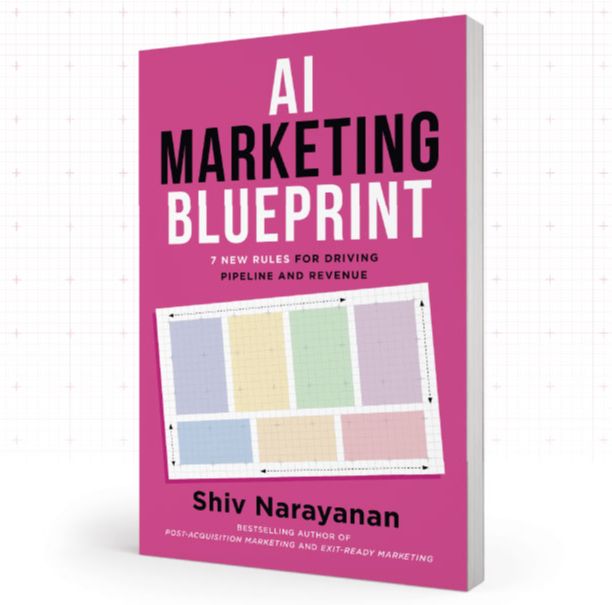
For those of you who have been to some of my sessions before, a big thing is that I try to focus on evergreen concepts that are going to continue to apply for years to come. This session in particular will build on my book, The AI Marketing Blueprint. I did a webinar on it a few months back; this is expanding on those concepts and taking it to a much higher degree. You’re going to see the evolution there as well. A lot of the concepts from the book are playing out in real time, and a lot of it is actually starting to come true, which is interesting to see. I highly recommend you check out the book if you haven’t already.
One thing we won’t do is cover tips and tricks, because those things evolve all the time. There might be one prompt that’s really working right now, and tomorrow that’s going to change, for example. Instead, I want to really get you guys to think about the problem in the right way. Let’s get started.
Why is inbound traffic declining?
If you look at the traffic of a lot of companies, this is kind of how it trends: it slowly increases over time, and quarter by quarter, you see growth. And then HubSpot famously said about a year ago, maybe a little bit more, there was a huge study that came out which said that HubSpot’s traffic had declined by almost 80%. They had a ton of these inbound articles that historically were written and did really well. Inbound was pioneered by HubSpot, and they saw this huge dip. Similar dips are being experienced by companies—maybe not 80%, but I’ve seen 30, 50%, or 25% across organic and paid.
A big reason this is happening is that, at the end of the day, it’s about real estate and share of visibility. If we think about Google search and what people are looking for depending on different types of queries, historically, all that we used to see were a few ads at the top, the organic results, and maybe a couple of ads at the bottom. That was the entire page of Google. This was the case for over a decade. Even if there were some evolutions—maybe some FAQs or snippets at the top—in general, that was what Google search looked like.
Now, if you go on Google search, there are several more things going on. There is the AI overview, there are snippets on top of that, and then there are sponsored links. There are sponsored links inside the AI overviews. If you combine all of these things together, the first page of Google looks so different than it did even two years ago. Even if you are one of the top 10 links in terms of organic traffic or organic results, instead of being one of, let’s say, 13 links on the first page, you are now one of probably 50 links. Just as a share of real estate, the percentage value has gone down. If you’re the fifth organic link, you’re basically invisible. If you’re the first organic link, maybe you still have some hope. But in general, that first link that’s an organic result on Google is still getting less traffic than that page historically would have.
On top of this, we have AI overviews that are changing how we click and interact with certain links. If you are the first-position link on Google, you would still see a significant reduction in click-through rate. In some cases, it’s north of 50%. If historically you got 10,000 visitors from ranking for a particular keyword, you are now getting 5,000 or fewer visitors for that same keyword. This is true in almost every single market.
At the same time, you have Google Ads that are getting more expensive. Coming back to this concept of real estate, as there is way more real estate to fight for, the premium on the sponsored links at the top has just gone up significantly. People are trying to bid more so that they can get a share of the traffic. Meanwhile, customers are clicking fewer links because they’re getting a bunch of questions answered without ever going to a particular website. There are some industries where we’re seeing cost-per-click of over $50 because of how competitive it is. There are also more competitors if you think about how much easier it is to stand up product solutions now. There are more competitors in every single vertical and every single industry.
Why does being cited by AI platforms matter?
At the same time, if you are cited in the AI overviews, you end up getting more clicks and more referral traffic from all sources because AI overviews are referencing you and citing you. I would say this is the canary in the coal mine. It’s important to understand that if you are visible on the AI overviews and in the AI answers to queries asked on AI platforms, you have significantly more power as a brand. Customers are trusting AI platforms with their decision-making in all markets and industries.
This is an article published by AirOps, and there are a bunch of different studies cited here from SEMrush to BrightEdge, Ahrefs, and a few others. It talks about the idea that the value of being cited on AI overviews and answers, in some cases, is 23x in terms of conversions versus not being cited. The value of an AI visitor is 4x more than a traditional organic visitor. The CTR lift is significant. The point here is that if AI platforms are recommending you, it means you have more trust with the buyer and they’re more likely to convert with you.
I covered this in past webinars and also in the new book: the buyer journey has shifted. When buyers talk to you, it has moved further down the sales cycle. Historically, they may have clicked a bunch of links on your website and signed up for a demo. Now, they’re just conversing with AI platforms until they’re finally ready to buy from you. This means they’re educating themselves through AI overviews and AI platforms. They never come to your website, never sign up for a demo, and never talk to any of your sales reps. When they’re finally potentially ready to buy, they will come and talk to an account executive or just sign up for a free trial and convert to paid.
Understanding this is the key to really understanding why you’re seeing declining traffic and pipeline everywhere. There’s declining SEO and top-of-funnel traffic because, instead of searching on Google and clicking a link, they’re just asking ChatGPT or Gemini questions. Instead of going to G2 and Capterra to look at reviews, they’re just asking AI platforms to compile a short list of options or asking what reviews are saying. Instead of signing up for a demo, they’re building a list of requirements and asking AI platforms which one is the best option for them. If they’re going to build a business case, they pick the one that is the best fit for them. That leads to higher close rates for the ones being cited and significantly lower close rates for the ones that are not being cited.
How should you approach demand gen and content in an AI search world?
All of this means that we need to build a new framework as a way to think about how to approach demand gen, content, SEO, and AEO in this type of market environment. I’d say there are five things to keep in mind. One: build an updated mental model for looking at what content production and demand gen mean in this world. Two: create a new baseline for your business. Third: figure out the queries you actually want to show up for. Fourth: figure out your gaps in citations across these platforms. Five: scale distribution.
Build an updated mental model
A concept I’ve talked about previously is that the long tail has changed significantly in an AI world. Historically, a long-tail query might be something like “top 10 CRM software for small businesses.” That would be considered long tail and would have slightly less volume than “top 10 CRM” or just “CRM software.” Now, I can give way more context about my business. I can state how much I’m doing in revenue, how many employees I have, how much pipeline we usually get, and what functionality I’m looking for. I can ask all kinds of detailed questions before actually submitting that query and get a very specific solution from the AI platform.
This matters from an organic traffic standpoint. We have some clients that are market leaders in their space. Historically, they would have top-of-funnel articles like the equivalent of “What is a CRM?” The volume for a keyword like that—if you have a page that addresses it and you rank—might get 500,000 visitors a month. Some of them might be qualified; you capture their email, nurture them, and they’ll turn into leads eventually. But when you think about queries like that, they are very broad and informational. The amount of competitors out there is significant because anybody can answer the question “What is a CRM?” It does not need to be specific to you as a business, and the AI platforms themselves can answer it because it’s in their training data.
On the flip side, there are very specific questions that AI can answer by itself without having a source, and it adds a lot more context from the customer’s perspective. The flip side might be: “Best CRM for a 20-person agency that needs it to sync with Salesforce.” The volume for these kinds of keywords is going to shrink as you get deeper, but it’s super relevant to what you’re trying to sell. Because of that, competition decreases. This is the kind of stuff we actually want to rank for.
If there’s anything we want to index on more, it is context. This goes back to product marketing fundamentals. If we were to simplify the product marketing process, we first have to define our ICP: who are we for, what personas, verticals, size of accounts, ACV, etc.? You translate that into the messaging and disseminate that across all your platforms. Great product marketing looks at underlying data, and you’re able to segment your best-fit customers from your worst-fit customers. Your best-fit customers will have better metrics across the board.
The same is true as you’re producing content for AI platforms. AI platforms are trying to figure out who is the best-fit customer for this type of business. When a person has a specific query, which company are they the right fit for? Context is the key. What we really need to educate AI platforms on is the context in which you should be chosen over an alternative. What are your winning points and situations, or where do you have a right to win versus others? This is why your content needs to address situations that are for specific use cases. It should be for a specific ICP, stage, size, revenue, and complexity. It should address specific problems and challenges that your ICP will be facing. The more context you have, the more AI platforms can train themselves to understand: “This is the scenario where you win.” They are then more likely to recommend you as one of the solutions.
This goes a step further. A big part of how we research on AI platforms—and you have probably done this yourself—is different than how we used to research on Google. On Google, we would do one or two queries and then go to multiple resulting links to try to get answers. On AI platforms, queries cascade. I am sure you have done this where you might start with a core query giving context. For example: “I tore my ACL, I need a recovery plan, what are some things I can look into?” As you go through that, the next one might be: “What are some things I can buy that might help me walk?” You go down these questions; they keep branching into more conversations. It’s a back-and-forth similar to how you would have a conversation with a sales rep. It’s very different from doing a Google search and clicking links to self-educate. In the old world, you were trying to cascade through questions by self-serving through websites. Here, you can just self-serve through questions.
Understanding that every question is related to a future or past question helps you see how things work down to an ultimate decision. An example would be: “What is the best solution for my particular situation?” I give context, then ask: “Does this integrate with something? Does it meet my compliance requirements?” “I’m located in Europe—does it meet certain legal restrictions? What are the alternatives?” “What is the reputation? What are people saying in reviews? What’s the ROI and business case?” Already six or seven queries deep, my understanding of the best solution is dramatically improved compared to that first query.
This is a framework from a friend of mine, Steve Toth, who runs SEO Notebook. He talks about the “brand truth framework.” The idea is making it structurally clear to AI platforms who you are for and addressing all the questions someone would want to ask in that situation. You make that content discoverable so when that question is asked, the LLMs understand that this is the best possible solution. You need to make this discoverable through all content you produce: not just your blog, but solutions pages, help sites, and every video you create. That underlying brand truth framework is what trains the data to answer these cascading questions.
Create a new baseline
Understanding this, we can now look at more technical ways of approaching it. You might build an exhaustive list of detailed queries and track how you show up in terms of visibility on ChatGPT versus Claude, Gemini, AI overviews, or any other potential AI platform. Where are we completely invisible, where can visibility be improved, and where are we in a good place? Most clients we’re working with do not have good visibility across the board. In most cases, they’re at less than 20% on the types of queries they want to be cited for.
Similarly, you would want to do a comparison of your share of voice, citation rate, or mention rate versus what your competitors are doing. If you build an exhaustive list of queries and map it to yourself and your competitors, you can see which ones are being cited more. It gives you a clear idea of whether you have an edge or not. If you have visibility and citations on these AI platforms, your conversion rates can be significantly higher compared to the competition and even just in basic organic ranking.
The last thing is to look at the sentiments being projected on these platforms. Does the AI look at you as a strong solution or a weak solution? Is it a positive or negative outlook on the value the customer will get? The stronger the positive sentiment, the more likely it is to influence decision-making in your favor.
You want to establish an AI visibility baseline. We do this by building an exhaustive list of queries, especially those related to buying terms, late-funnel terms, and extensions of those terms. We start to look at: are we actually being cited? What percentage of the time? On which platforms? You build a heat map and track these new metrics. Where historically you might have tracked ranking positions and clicks, now you’re looking at your share of voice in AI answers, citation frequency, brand search volume, and ultimately the revenue impact from AI attribution. These new metrics should be your dashboard.
It should look something like this, where you look at how many responses you want to be in and what percentage of the time you are actually showing up. This is anonymized data from one of our clients. We’re seeing numbers like this, and I would say this is on the higher side; most companies are below 20% across the board.
Figure out the queries you want to show up for
Then the question becomes: how do I figure out all the queries and searches I want to show up for? What’s the methodology? I’ve mentioned in the past that one of the things we need to do is train and enable AI like a sales rep. We need to make training data discoverable to the AI similar to what we would do for a new sales rep. We give them market knowledge, customer insights, pricing, and product information. Often, this data lives in private drives and is not discoverable by AI platforms. We need to democratize that and make it visible in a schema that the AI can actually consume.
The next part is to map new queries to key questions people ask during the sales process. For example, a lot of customers will ask: “What is the ROI of this investment?” or “What are the alternatives for this solution?” I recently searched for running headphones. It gave me recommendations, but then said: “Beats are great if you want to lock in and run, but a downside is that you can’t hear outside traffic.” It suggested other headphones that allow you to hear outside noise for safety. Immediately, that introduced another criterion for me, and I did a follow-up search: “What are the best headphones for being present about traffic when running outside?” That changes my criteria. As we think about these questions, there are a bunch of subset questions that help us understand the entire universe of questions a customer would be asking.
To build an exhaustive list, you already have a ton of data sources. You have sales call transcripts from recordings with customers. Go through those and parse the most common questions. Go through support tickets. Look at what people are saying on Reddit. Look at related searches. Look at the reasons why you win and lose deals. Look at review sites to see what people are saying and what questions they’re asking. These sources give you visibility into queries that go way beyond general, high-level terms like “top CRM software.”
At the same time, you want to build out cascading queries. There’s this idea of “fanning out” queries from seed queries. A seed query might be “best CRM for a small agency,” but the follow-up could be “that syncs with Salesforce,” “that migrates easily from HubSpot,” “that is SOC 2 compliant,” or “is under $50 per user.” What are those additional fanned-out queries for your segment? You’re going to see way more opportunity for content. This is where some of the biggest gaps are; companies might have something for the seed query, but nothing for these additional types of queries. These are super relevant in an AI world because that is the conversation your prospect is having.
Context is very important. The more you understand your ICP and their specific situation, the more specific your content becomes. It addresses the buying stage, realities, or pain points they are solving for. That helps you understand where the gaps in your visibility are.
Close your citation gaps
Eventually, you should look at it like this: a bunch of topics where you can see your mention rates, citation rates, and share of voice. You can figure out which ones to invest in, and that should convert into an updated SEO and AEO roadmap.
It’s important to understand that we are not building content for technical reasons. It’s shocking that companies still pump out content—even using AI—that sounds very generic or oversimplified. They just put out a piece to touch on a keyword they want to rank for. You actually want to make it super valuable. The more valuable your content is, the more likely AI is to use it for citation. What drives value? Good research, great sources, quotes from customers, or real-life examples. If we can make it readable in a way an AI platform can use to answer queries, that makes the content higher quality.
On the technical side, you want to re-architect existing and new content for AI consumption. Build specifically for your target ICP. Answer as many long-tail queries as you can. Look at fanned-out queries. Answer cascading follow-up questions. Create all-encompassing, easy-to-cite content. This is going to lead to AI citing your content a lot more.
Scale your distribution
As you’re doing this, you need to scale your distribution. This is the main thesis of my book, The AI Marketing Blueprint: be out there more. Training data is living on all these other platforms. Step one is identifying core pain points and who they are for. Once you have the roadmap, disseminate it across all platforms.
If we look at citation sources for AI queries, some of the most common are places like Reddit, LinkedIn, YouTube, Medium, and Facebook. The frequency is significant. Yet, most companies don’t produce content for these platforms; most of their content lives on their blog, or inside their drive as a sales enablement asset.
I want to highlight a couple of sources. This is another study by AirOps showing that brand and product content dominates in a lot of industries. When you are getting close to a purchase, that is when you do a ton of research and have more follow-up questions. Like the headphone example: I could go watch five to 10 YouTube videos on different headphones to see what it’s like to run with them. Those things are super relevant to queries that are difficult to duplicate unless you actually produce that content.
Where does that stuff live? If I’m asking general questions, maybe it lives on Wikipedia or a general directory. But if I’m asking specific questions about reputation, what people are saying, results, or ROI, suddenly Reddit and YouTube become more important. This is an example of Reddit’s share of citations in ChatGPT. It was high in August and has gone back up to about 30%. The reason is that you get real-life feedback from people, which helps answer those queries.
On the flip side, YouTube’s share of citations has gone up significantly. I’ve been saying for a while that over the next five years, B2B companies will launch major YouTube channels. If you haven’t done this already, it needs to happen. YouTube will be a top source for AI platforms because it factors in authenticity. There can be a personality behind it, and you can answer questions on video that you cannot in other formats. It can be repurposed in so many ways. Platforms like Gemini have full access to YouTube’s library as training data. They see what users are watching, how long they watch, and what they find helpful. It’s the second biggest search engine in the world for a reason.
Hyper-focusing on these platforms can help you drive citations significantly. The answer will change depending on your business. TaylorMade invests heavily in YouTube and Instagram because that’s where their market is. If you’re selling healthcare software, maybe you don’t need Instagram, but you should be on YouTube. The point is: you better have training data sourceable from these specific places to increase your mentions.
I see questions coming in the chat; please keep putting them in, and I’ll get to them at the end.
How should you adjust paid media?
The last thing I want to talk about is paid media. Even though it’s not directly related to AI visibility, it is a major source of pipeline. Historically, companies got a bunch of volume from campaigns, and now it has fallen off a cliff. A big part of the reason is that AI overviews are taking over real estate. There are workarounds—ChatGPT now has ads embedded in answers, and you can see sponsored links in AI overviews at times. Regardless, companies are seeing a decline. CTRs in situations where an AI overview is present have gone down significantly. If it was historically 20%, now it’s closer to 6% when an AI overview is present. Most searches related to buying keywords have some sort of AI overview.
Because of this, we need to adjust how we look at paid media. There are some basic strategic adjustments. Number one: bid on intent, not volume. The idea is to work backwards from people who are most ready to buy. We have to be even more specific. If you’re selling project management software, bidding on “project management” is not a good idea. Even though it has 2 million searches a month, someone searching that is likely looking for something informational. They might just want to learn about Kanban or Scrum. If you bid on that, your cost of acquisition is really going to increase. Instead, come back to those detailed queries with additional context for your ICP. Those are the things you want to bid on on the paid side.
For different types of campaigns: branded terms you want to scale up or leave as is. People search for you by name; you want to be visible and defend against competitors. For late-funnel terms—someone searching for your specific solution for their specific context—you want to scale that up because you have a right to win there. Things like broad match, earlier funnel, or mid funnel, you should likely be scaling down. This is where the waste is; money is going into campaigns that don’t drive pipeline. Retargeting and ABM can continue as is. You want to scale up paid social investment because you can target your ICP directly, and it’s not affected as much by the issue of Google’s search real estate.
You definitely want to start investing in paid AI placement. Market leaders are already doing this. It’s low-hanging fruit, especially for contextual queries that relate to what you’re selling. CTR on AI platform ads is significant and leads to more purchases because users trust the AI recommendation.
How do you keep track of your AI visibility?
The final thing I’ll say is to keep tracking these metrics. Do this for all the queries you want to be visible for and track that visibility over time. Are you increasing or decreasing in citations? One big thing about AI that is different from Google: historically, if you ranked on the first page, you were good for the foreseeable future. On AI platforms, that is not true. You have to stay relevant because things keep evolving. More content and videos are published. More training data appears on Reddit or Instagram. You have to stay on top of this visibility and audit whether you are trending in the right direction. Sometimes core keywords can fall off, and you’ll be scrambling to recover traffic. Ultimately, have a dashboard that looks at key metrics: brand search volume, mentions, top-of-funnel social metrics, and visibility for your target keywords.
That’s pretty much it. I will stop there and let’s do some Q&A. The QR code is here for the slides, and we’ll also send them in a follow-up email.
Presented By

Shiv Narayanan
Shiv Narayanan is the Founder and CEO of How To SaaS. As an advisor, consultant, and fractional CMO, Shiv has helped B2B companies create hundreds of millions of dollars in enterprise value with marketing and demand generation.
He is also the bestselling author of AI Marketing Blueprint, Post-Acquisition Marketing and Exit-Ready Marketing, and the host of the Private Equity Value Creation Podcast.
AI Marketing Blueprint
7 New Rules for Driving Pipeline and Revenue