
How to Structure Your Marketing Team to Maximize Impact
Get the slides for this presentation
Summary
In this webinar, Shiv Narayanan, Founder and CEO of How To SaaS, shares a framework for working out the right marketing org structure for your business and building the business case to grow it. He covers:
- the four inputs that should shape your team
- the seven marketing sub-functions, and how deal size changes which ones you need
- the five phases marketing organizations move through as they grow
He also answers audience questions on hiring a CMO, reporting lines, salaries, and headcount versus program spend.
Key takeaways
- Base your marketing org structure on four inputs: your stage of maturity, your business model, the growth opportunities you need to prioritize, and your revenue targets and budget.
- Deal size and the size of your target market decide which sub-functions matter. Low-ACV, self-serve businesses lean on paid search, paid social and SEO. Enterprise businesses lean on ABM, sales enablement and customer marketing.
- To get headcount approved, show where the business is, your strategy, the opportunity you’re not capturing, the people you need to capture it and the ROI they’ll generate. Skipping straight to the headcount ask rarely works.
- Marketing teams move through five phases. They start as a small team led by a full-stack marketer and end as regional or product-line teams supported by central centers of expertise.
- Hire the right leader for your phase. Over-hiring a CMO for an early-stage team is as costly as under-hiring a VP of Marketing for a complex one.
- Spend far more on programs than on headcount. A 30/70 split is healthy, and 20/80 is highly efficient.
- Once marketing is responsible for generating pipeline, it ideally shouldn’t report to the CRO.
Transcript
Speaker: Shiv Narayanan, Founder and CEO, How To SaaS. Lightly edited for readability.
Why is it so hard to get approval for more marketing headcount?
Okay, let’s get going. Today is going to be a bit of a shorter session. If you were a part of the last webinar that we did, that was about a 45-minute talk, and we went through a lot of complex concepts and kind of stacked them on top of each other. What we’d like to start doing is having shorter sessions, maybe 20 to 30 minutes in length, and spend more time in Q&A. Last time we only had about five to ten minutes left over at the end of it all, and that gives us an opportunity to answer specific questions that you may have for your organization. At the same time, we can go through these shorter sessions and put out more webinars instead of having them spaced maybe a month apart; maybe they can be more frequent than that.
So again, today this is a topic that a lot of our clients talk to us about. We’ve seen it as a question generally in the marketplace in terms of what your marketing team needs to look like for you to maximize the value that you’re capturing from the marketing side of the business. So, we wanted to spend some time on that. Depending on wherever you are as a business, the answer for you is going to look different. So, we’ve done our best to walk you through the framework or way of thinking about that for your business so that you can get to the right answer for your particular situation.
In terms of your realities and what we’ve seen as the most common, something that we hear and see all the time is that marketing teams are usually small and mighty. They’re usually in charge of a lot of items: projects, tasks, initiatives, and large revenue targets, but yet the team is quite small, often a few people. There are aggressive growth targets that are being set by the board or by the executive team. There isn’t nearly enough bandwidth to execute on what’s needed to hit those targets or do all the activities that we need to do to be able to take the company to where it needs to get to. At the same time, there’s an inability to get approval for additional budget for the additional headcount that’s required to be able to do the things that we’d like to do. So, what we’d like to do is provide you with a framework to be able to get a “yes” to expanding your marketing team, regardless of the situation that you’re in, and give you a framework to think about that.
What should determine your marketing org structure?
Before we can do that, it’s important to understand what are the critical inputs to figuring out the right work structure. What I’ve seen inside most businesses is there’s almost like a wishlist of roles that we need, and we just go with whatever budget has been approved and pick out the one or two roles that we require most, and that’s the one that we end up funding. Instead, I think a much better way to get to that structure is to figure out a scientific way to get to an answer. What does the right org structure for marketing look like for this business, and what does the hiring roadmap look like as we’re trying to build the right organization for the company?
In thinking about that, I would say there are four critical factors to consider and use as inputs into that ultimate decision of org structure. The first is what stage of maturity is the business at? Depending on where you are—whether you’re a startup, series A, owned by private equity, or you have multiple products—the answer here is going to look a lot different. Number two is your business model. Are you selling a low-priced ACV type of product to a large market, or are you an enterprise B2B company with very limited targets that you’re going after? That will inform who you need to execute on your marketing strategy. Third is what are the growth opportunities available to your organization that you need to prioritize? For example, is cross-sell/upsell a really big initiative inside your business? Then your team will look different than if net-new or inbound marketing is the focus. So we want to factor those in. The last piece is what are our revenue targets and budgeting plans that have been made available to us? We can use this information to inform this org structure and perhaps even plug into this budgeting cycle to make the right business cases.
This is a framework that I’ve shared in the past, so I think it’s critical to understand what is the starting point of the business. Are you in an organization where it’s more of a new go-to-market? That could be either a startup or a new product that’s being launched. In those cases, the marketing team for that new product or startup is quite limited; sometimes it’s founder-led, sometimes it’s one or two people. Number two is sales-led, where sales is the primary revenue driver, marketing is a support function, and marketing generates less than 10% of the pipeline. Third is nascent marketing. Marketing investment is still quite limited—less than $300,000 in most cases. The marketing team is less than three people, and the pipeline generator is still roughly around 10% or less. Then there’s “some marketing impact,” where you have four to seven people and the pipeline contribution is 10 to 20%. Then you have sophisticated marketing organizations that are 25 to 50 plus; in some cases, we’ve even seen 70 to 80. The marketing team is larger than 10 people.
The way to think about this is as you’re going through the different stages here, the size of marketing teams scales exponentially. We have one client as an example that has over 100 marketers on their team, but they have 20 product lines plus. They are doing $800 million in revenue across different geographies, markets, verticals, product lines, and segments. For them, having 100 plus marketers makes a ton of sense. Then we’ve seen clients that have $5 million in revenue and they’re closer to the sales-led model, and they have three marketers on their team. Really understanding where you are as a business is the starting point. If you’re in a sales-led organization, trying to pull together an org chart that says we need 20 people or 15 people to make marketing actually successful, it’s very unlikely to get funded. Conversely, if you are in a sales-led model, you may start with two or three critical roles, prove out what’s working and what’s not working, and then use business cases to draft the right funding for additional initiatives. That’s how you get additional headcount.
Similarly, you want to look at your go-to-market model against your cost of acquisition. Inside businesses that are self-serve—if I think about a company like Calendly—having an enterprise sales team is usually not applicable to most customers. They may have an enterprise plan for which they have some sales reps, but in general, Calendly is using a no-touch approach and their cost of acquisition is very low, as is their price point. As a result, their marketing model will look quite different than a company that’s selling enterprise products. I think about Salesforce, Hubspot, or Microsoft Dynamics; they’re going to have large sales teams with a large price point for their offering, and they can spend a lot more on their CAC as well. So, understanding that is critical.
That connects to who you’re actually going after. This is a model that looks at your ideal customers and your target market with a filter of deal size and how many people are actually out there. Let’s say you were targeting the 500 biggest consumer packaged goods companies in the world. You’re likely going after “whales,” and your average deal sizes are north of $300,000 and potentially even north of a million dollars. That’s your entire account list. Conversely, if you look on the other end, a company like Calendly may have a lot of customers on their free plan and then some customers paying $10 a month, where their average deal size is closer to $100 or $200 a year. You have a bunch of other variations in between, where there’s deal sizes of $1,000 to $5,000, $5,000 to $50,000, and $50,000 to $300,000.
Depending on where your business is trying to find customers, your marketing org structure will need to look quite different. If we are targeting the 500 largest CPG companies in the world, we’re going to have a very heavy sales team because we know we can spend up to a million dollars to acquire that customer and still break even in the first year. The marketing efforts as a result will be focused on enabling the sales team. Sales enablement becomes a focus, product marketing becomes a focus, and account-based marketing becomes a focus. Conversely, if we’re hunting “rabbits,” “deer,” or “mice,” we may be going after the approach of inbound, self-serve, and more digital channels, keeping our CAC in check without spending too many dollars on acquiring customers where our payback period is north of two years.
Our total addressable market follows that as a result. If there are only 500 CPG companies out there, we likely are going to need to do one-to-one communication for those accounts. Whereas if anybody with Google Calendar can be a customer of ours, then we have to take a one-to-many approach. Depending on who you’re going after, you need to have some sort of a total addressable market analysis or segmentation analysis done to say, “Our market size is worth $5 billion and it’s made up of 5,000 accounts,” or 500 accounts, or 5 million accounts. Depending on that, that’ll inform what type of marketing team we need because we need to work on different activities.
Which marketing sub-functions does your business need?
So then the question becomes: what do those activities look like? We like to bucket marketing into about seven to eight key sub-functions. You have demand generation, and a bunch of things can fit into demand gen, but primarily we’re defining it as programs and campaigns that are focused on driving pipeline. Then you have content marketing, which is about making sure we have assets for every stage of the buyer journey so that the buyer can educate themselves, or we can use content to get them to the next stage in their journey until they’re eventually ready to purchase or stay with us as a customer.
Third is customer marketing. This is where we are marketing to our existing base and driving either upsells or cross-sells to get them to increase their average deal size or how much revenue we’re generating per account from each of those customers. Fourth is product marketing. This is where we’re educating customers on the product, new functionality, and features. We want to improve retention and usage, and product marketing plays a key role in getting us to that point.
Then we have corporate marketing. This is more of the traditional marketing, which is brand, comms, events, and PR activities. This is essential as you continue to grow as a company. Depending on the market that you’re in—for example, if you are targeting CPG companies—you may need to go to all the big CPG events that are out there as a form of being present in that marketplace to catch all the right accounts into your funnel. You have marketing ops, which is about building the data infrastructure and reporting on all these different activities so that we have an idea of what’s working, what’s not working, and the ROI on certain marketing activities. Which channels are performing better than others so that we can reallocate budget? The last is sales enablement, where we’re supporting the sales team with the right collateral so that they can be more successful and close more deals.
As we look at all the items that we covered, when we get to this stage, the mix of activities for each business across these different sub-functions looks quite different. As an example, if we were to look on the left side, this might be what Calendly actually has to do, where their focus might be on paid search, paid social, and SEO as their primary drivers for getting users into the funnel from a marketing standpoint. They’re also obviously focused on product-led growth as their core driver, but from a marketing activity standpoint, they’re likely looking at these three. Conversely, if we’re talking about that enterprise B2B company that’s targeting CPG top 500 accounts, their mix might look like account-based marketing, sales enablement, and customer marketing to their existing accounts so they can grow the average deal sizes that those customers are spending with the core business. Depending on the business model, again, you have to keep coming back to this because this is the starting point for defining the right org structure for your company.
A way to filter this or a framework that you can use to think about this is if we look at ACV down this first column and map it against all of those functions that we just discussed. Anything in green is something that is essential for a company or product line within that ACV. Yellow is a lukewarm area where you would have some investment, but maybe not all the way. Pink is something that you just would not do in that business. For example, for Calendly to do ABM is quite unlikely, unless they’re going after the 1,000+ employee companies that need some sort of calendar management software. Conversely, for a B2B enterprise company, it makes total sense. Similarly, when you think about corporate marketing or sales enablement as a core revenue driver, they’re probably not as valuable for companies that have deal sizes under $5,000, but quite valuable on the sales enablement side when you have large deal sizes with long sales cycles and the sales team needs as much collateral as possible. You can filter all of these activities and start to think about what that mix looks like, how you would want to weight the limited marketing budget that you have accessible to you, and how you would weight the headcount that’s available to you so you can prioritize the right roles that need to be hired.
How do you build the business case for more headcount?
As you identify the right sub-functions that require focus and where you want to put weight, that’s when you want to start looking at the opportunities where you’d like to be able to scale. If you are, for example, looking at paid search or paid advertising as a core driver for the business, you want to take a look at how much room there is to scale spend in a particular business. For this business here, they spent about $24,000 in paid media. They generated about $38,000 in closed-won dollars and their ROI was 1.59. They can easily take that $23,000 in monthly spend and they could scale it to $50,000 potentially on a monthly basis, which leads to a $600,000 annual spend.
Similarly, you could look at content and map out which items we actually have from a nurturing perspective or a sales enablement perspective, what we need to build out as a priority, and what we push to later. For example, if you need sales enablement assets in the form of case studies and you don’t have that, that might be higher on your priority list as a way to figure out which headcount you need to support your growth plans. You may not, for example, prioritize product intro videos because that’s less of a need based on the type of business model that you’re in.
The last thing you want to look at, as you go through this type of work where you’re trying to forecast the ROI from the opportunities available and the investment required, is to actually look at overall budget needed. When you look at MQLs required and your conversion rates through the funnel—what percentage of MQLs get to SQL, what percentage get to closed-won, and what’s the dollar value of each of those deals—you want to look at whether you are on track or behind on an MQL basis. How much budget do you need if you need to hit some sort of a threshold? In this company’s case, their threshold is at $150 an MQL, so their marketing budget for 2022 would need to be $2.59 million. Are they underfunded against that, or do they not have enough marketing budget attached where they actually need to input more budget to actually hit those targets?
The next question becomes: if we are going to give them more budget, how would we deploy that? Some of the work that we just walked through is oversimplified—I’ve tried to give you a high-level view—but you would want to do this work for every single channel and come back to these budgeting metrics to say, “Here’s how we would increase our budget.” Let’s say the budget used to be 2.29 and it’s now 2.59; that’s about a $300,000 increase. This is how we would deploy it in terms of programs across different channels or potentially even headcount.
If you think about it as a process, the way to build business cases is to look at your available growth opportunities, bring that and map it against your revenue targets, and add in a layer of how long it will take to generate an ROI on our investment and what is the time horizon for that. You eventually take that to an investment committee where you get approval for additional budget, whether it’s headcount or programs, and then you bring that budget to fuel the next steps in your marketing org structure.
What ends up happening in a lot of businesses, or in terms of just planning for headcount in general, is marketers often skip to this step or do these last two things. But because these first three steps have not been completed, it’s very unlikely to get the budget that we want. When we’re going for a headcount ask, we want to say, “Hey, this is kind of where we are as a business, here’s our strategy, and here’s the opportunity available to us that we’re not capturing.” “In order to capture it, here are the people we need, here’s what they’re going to be working on, and here’s the ROI they’re going to generate.” “So now we need this headcount to be able to fund us to the next level.” In those cases, you’re far more likely to get your budgeting asks, and your asks for headcount are likely to be far more reasonable. The more reasonable it is and aligned with what the board is planning anyway for the business, the more likely you are to get budget for whatever it is that you want to do.
What are the five phases of a marketing organization?
So, I’d say that’s roughly the framework. What I’ve done from here is talk about the different phases of marketing organizations, and I’ve taken you through five here, so I’ll show you that. There can be many more variations, but the point here is to say: understanding where you are as a starting point and then following the steps that we just went through to be able to say, “We’re starting with two or three people; how do we get from two or three to five, to seven, to 11, to potentially 20 people on the marketing team?” There is a process in understanding where we are as a business and which phase we’re in.
Phase one
Phase one is usually where a lot of startups or founder-led businesses find themselves. There’s some sort of a marketing leader, a content marketer on staff, or a management specialist. These people are quite junior, and everything else is usually outsourced to freelancers—for example, for design or development. Maybe there’s even an SEO specialist or an agency that we’ve hired, but the marketing team is quite limited. This is more than enough to get marketing programs off the ground and get proof points in the form of data that we can take back to the CEO or to the board. It really relies on this person being more of a full-stack marketer. So, that has to be the key hire: somebody that can write, run campaigns, build ad creative or write ad copy, and be able to do some reporting that we can take back and ask for additional budget.
Phase two
As companies grow past that stage, you have a third tier created where you now maybe have a VP of Marketing. You have directors for each functional or sub-functional area of the business, and then you have specialists underneath those people. Under the demand gen person, there might be one paid media specialist and a paid media agency. Under the director of content, you might have a content specialist and a product marketing person. You might have SEO split out, especially if you’re more of an inbound-driven business, and an SEO specialist underneath them, maybe even an agency. Then you have a marketing ops manager, and these four people are the ones reporting to the VP of Marketing. I would say the companies that have this type of an org structure are roughly at that $7 to $10 million or $5 to $10 million mark. Their marketing team is somewhere in that range where they are making an impact and they have directors under the marketing leader, but they’re not a fully fleshed-out marketing team yet and there’s a lot more growth left to capture.
Phase three
Phase three is when there are a lot more roles that can be added underneath the functions that we just listed. You may have, for example, a corporate marketing team emerge where you have an events manager or a PR/comms leader under that person. You might have additional roles under each of these people as well, and the revenue targets are likely ramping up for the VP of Marketing. Your number of MQLs or the pipeline that you need to drive for marketing within this organization might be 2x or 3x what it was for an organization that looks like this. Likely, I may have even been a little light on the roles; there might be one, two, or three additional people inside an organization like this.
Phase four
Phase four—and this is where I have drawn a distinction between what a VP of Marketing does and what a CMO would do—is there’s a lot more purview that the CMO has and a lot more budget that person has access to. You can see there’s a dedicated product marketing team and a dedicated corporate marketing team. Inbound and outbound demand channels have been split up. Maybe SDRs or BDRs are reporting into the outbound demand function. Maybe they’re in sales, but oftentimes we see this model as well. There are multiple agencies involved: somebody that’s helping with paid media, somebody helping us write content, or a Salesforce partner on the marketing ops side. There are just simply a lot more people under the leadership of this person. I would say organizations that are at this stage usually are north of $20 to $25 million in revenue and they’re experiencing significant growth. So there’s a need for enough people to be supporting all the different marketing activities that the business needs to work on. Oftentimes, these types of companies also have more than one product line. But this approach, as you’ve seen, is totally functionalized; it’s not split out by product line. That’s because these companies have not reached a level of scale where needing to separate out by product line makes total sense yet.
Phase five
That brings me to phase five. This is a simplified org chart just to give an idea; there would be maybe 2x the number of people that you see in phase four. But what you would see is you have regionalized or product-line focused teams. For product line one, product line two, product line three, or different geographies like EMEA, APAC, or North America, there are different sub-functions under there. In terms of content, product marketing, customer marketing, and sales enablement, that’s regionalized or product-line focused. Then you have “centers of expertise” in marketing ops, corporate marketing, and demand gen that help all of those product lines across the board.
We usually see this in businesses that have five to ten-plus product lines, where M&A is a key part of the growth strategy. There are companies being bought every quarter and there’s a ton of complexity, so you need some sort of a core parent-company-level marketing team that’s handling some of these core functions. But at a product line level, the content looks different for each product line. Maybe the language is different. Maybe there are legal distinctions in each of the product lines that require some level of subject matter expertise. So, having this type of separation is critical there. Here you can see that because there’s so much more complexity to manage, the CMO here has to be far more talented than the VP of Marketing at phase three or phase four, because that person is usually managing fewer product lines.
Depending on where your company is, you’re trying to navigate your company through these phases as you grow. If you’re at phase two, you likely have items on your roadmap that get you to phase three. If you’re at phase three, you’ll likely have items on your hiring roadmap that get you to phase four, and so on. So, it’s important to identify where you are on that journey, prioritize roles accordingly, and have the right business cases to be able to prioritize those roles.
What else should shape your marketing team structure?
The main takeaways—and I can see we’re coming up on 25 minutes here, so I’d like to jump to some questions—is building the team for your right context. That includes looking at the stage of maturity, business model, strategy, the growth opportunities available, overall financial targets, and the budgeting available. Additional factors that get brought in are the number of product lines, your geographical expansion plans, and potentially the M&A activity involved in your context. That can change some of the dynamics. An example of a role that’s not listed in this would be an integration manager. Especially as more product lines are acquired, you probably need somebody who’s in charge of bringing in a new business line into this structure to make sure nothing skips a beat as you’re integrating the companies together. Factor all that in, but at the same time, you’re still working through the core functions that are needed for each of the different product lines.
So I will stop there, and let’s see if we can get to some questions and go from there. If you have any questions, feel free to put them in the chat.
Questions from the audience
How do you balance brand and demand strategies when it comes to team makeup?
Roberta is asking, “How do you accommodate for brand versus demand strategies? Which is heavier on one or the other, or even a mix when it comes to team makeup?”
That’s a great question, Roberta. That really depends on the level of maturity of an organization. One of the things that I didn’t cover in going through these phases is I just talked about how the team evolves, but the stages of maturity that we talked about up here are actually independent of those stages. You could, for example, have a company that is very sophisticated in its marketing efforts and look more like this. We want to be able to figure out, in a particular business, have we captured as much demand as possible that is available for us on the marketing side?
Let’s say we’re more of a mid-tier ACV type of business where we’re hunting customers that are between $5,000 and $50,000. Our mix of marketing tactics would look like a combination of inbound, some ABM, paid search, paid social, product marketing, and sales enablement. So we have everything being run across the board here. The first question would be: are we capturing enough value from all these existing avenues and sub-functions for the business? Until we’ve maxed these activities out, going down the route of brand building can be risky. But at the same time, it can help us feel how much pipeline is coming from paid media, as an example.
I think earlier on, if you’re in the zone—let’s say you’re at about $5 to $10 million in revenue—the focus should be more on maximizing these channels. But as you start to find scale and see year-over-year growth, your number of MQLs or pipeline per month is increasing, and there is a core set of activities that you know drives value for the business. At some point, you would shift from being more focused on capturing demand to focused on actually creating demand. That’s where you would focus on thought leadership activities and becoming more of a leader in the marketplace for that particular industry. That would inevitably have an impact across the board here.
One of the mistakes that we’ve seen is companies will, before they figure this part out, launch a podcast or a video series. That is good and will pay some sort of dividend, but because some of these fundamental pieces are not in place, your conversion rates through the funnel won’t be good. Maybe people come to the site and they bounce right off because your website is not structured the right way. You want to make sure a lot of those core pillar pieces are in place, especially when you have a limited team. If your marketing team is three to five people and half of them are working only on thought leadership pieces, that can create a problem when it comes time to actually hitting those targets.
How do you hire and engage a CMO for their abilities?
“How do you hire and engage a CMO for their abilities?”
This is where understanding what stage you’re in is critical. For example, imagine you found a top-flight CMO and paid them top dollar to be a part of an organization that’s at this stage. Inevitably, you would end up parting ways with that person even though they’re super talented, because you’re likely paying them way too much to fill this role when somebody more junior can do this job. So, you want to be careful not to over-hire for the phase that you’re in.
At the same time, you don’t want to under-hire. If this is your actual need and you end up hiring a VP of Marketing, we find ourselves inside a lot of businesses that have really great VPs of Marketing, but they’re in the wrong seat and a different CMO actually needs to be there. Understanding and having self-awareness in terms of where you are as an organization and the pedigree of CMO or marketing leader you need, and then doing a search according to that, is key. For an organization like this, you have to find someone who has experience leading a multinational, multi-product-line organization or has the capacity to do that as the next step in their career. Not a VP of Marketing that leans heavily on the demand gen side, because more likely than not, they’re going to lean heavily there and some of these other areas are going to be ignored. It starts with understanding where you are as a business.
Is it better to hire from the bottom up or the top down?
James asks, “Is it better to hire from bottom-up or top-down?”
Great question. If we’re looking at an org structure like this, I guess the question is: do we staff up for these four roles first, or do we hire the paid media specialist before we hire the director of demand gen, or the content specialist before the director of content? That is a really, really great question. I think the answer depends on the org that you are in and the VP of Marketing that you have. I think, no matter what, this is the role to hire for first, and likely someone that leans towards demand gen and content because that’s what’s going to move the pipeline the most.
Then, if you have the right person in the seat, you could skip these two roles and have people being staffed up under them. But because they are leaning more here, you would likely need to hire director-level people, at least on the ops side. Corporate marketing is something that you could get away with a specialist on in the short term. I would say it depends, but you can skip. At some point, though, if there are aggressive targets, you don’t want this person who’s the VP of Marketing to be playing the role of Director of Demand Gen, because then they can’t support some of these other functions. So there has to be not that much time between when a junior person is hired and where this director-level person is hired as well.
Should marketing report to the CRO?
He asks, “How important is it for marketing to be reporting to the CRO instead of being a separate function, especially in multiple founder companies?”
In most cases, marketing reporting to the CRO is probably not a great decision, especially when marketing is in charge of generating pipeline. If you are a sales-led organization, odds are marketing does report to the CRO, and that comes with its own set of challenges. The CRO is usually not as plugged into demand gen activities—there are talented CROs out there, but in general, they are more sales-leaning. They don’t look at marketing as a pipeline source; they look at it more as a sales enablement function. Then marketing ends up being more traditional—it does events, PR, comms, and sales enablement—when it should be doing revenue-generating activities, which is demand gen, content, and activities like that.
We want to have the right structure, and depending on the phase that you’re in—if you are in phase one and you have two or three marketers—it really doesn’t matter where they report up to. But as you start growing through these stages of maturity, for people like this VP of Marketing or this CMO not to have a seat at the table with the CEO is kind of ridiculous. Especially when brand is run through this person, and the CEO should be directly connected to the brand. So I would say, ideally, not reporting to the CRO.
When does a Chief Growth Officer make more sense than a CMO?
“What are your thoughts about accommodating a Chief Growth Officer versus a CMO?”
That’s a question from Priya; that’s a great question as well. I would say a Chief Growth Officer becomes more relevant in phase four and phase five, especially as you have multiple product lines and other growth levers that can be pulled. For example, if you have payment processing running through your business and payments revenue is a critical lever for you, a Chief Growth Officer can bring together different product line leaders from product, sales, and marketing together to focus on that.
But again, it depends on the organization’s culture and structure. If there is a CRO in place and it’s more of a sales-led organization, a Chief Growth Officer probably wouldn’t be a good fit. But if a company has shifted to being more marketing-led and has a sophisticated marketing engine, then a CMO could eventually graduate to a Chief Growth Officer type of role and bring those functions together, and the marketing leader is then just focused on pipeline generation.
What is a CMO paid at a small to mid-sized business?
Sodhi is asking, “What is a CMO paid for a small to mid-sized business—not a fast-growth venture or PE-funded?”
It really varies. There are three or four variables. One is size of company. Two is stage of company in terms of marketing organization. Regardless of your size, if you’re a $5 million company but you’re marketing-led and your org looks like this, you need a far more talented CMO than if you have an org that looks like this. Third would be looking at the complexity of the marketing problem at hand. Even if it’s not a fast-growing venture, the more complex it is, the more unique the individual that you’re looking for. Then there are additional factors in terms of the cities that your business is actually running in. Are you a remote team, or are you operating out of San Francisco, or are you in Norfolk, Virginia, or something like that? Depending on where you are, there’s a ton of ranges. For a VP of Marketing, you could start at $150,000 on the low side and go significantly higher. A CMO for a large business at phase five could be making $300,000 plus easily.
How does sales grow alongside a growing marketing team?
“Have you noticed any patterns to how sales grows and adjusts alongside a growing marketing team?”
We’ve noticed that a lot of sales orgs and sales-led organizations can have even 40 to 50 people while the marketing team looks like it’s either in phase one or phase two. So, they kind of grow independent of each other unless there are significant investors involved and they’ve decided to fund all the functions quite equally. That being said, as marketing moves through these phases, ideally more pipeline is being generated. As more pipeline is generated, you need more people to service the leads that are coming in the door. You’re going to need more SDRs, you’re going to need more account executives, and you’re going to need more people to onboard additional accounts as well.
Usually we see sales teams grow, and likely you have, instead of just a VP of Sales and reps underneath that person, a head of account management, a head of SDRs, a head of BDRs, etc., being added as well. Then as you have certain activities—let’s say ABM is a core strategy for what you’re working on—that ends up producing a sales structure that mirrors this. ABM as a strategy usually follows from a heavy segmentation exercise where you look at your total addressable market, who are the top verticals, who are the targets, the top accounts, and then you need to have sprints against that. Marketing is producing content and campaigns for those accounts, and then sales has reps focused on those accounts. So, you need to have a sales team that can be agile enough to have a structure like that, and usually that involves more people. At scale, we’ve seen companies that look like this that have about 50 marketers, and on the sales side, they have 50 to 75 reps as well.
Should the marketing director lead UI/UX?
“Should the marketing director be leading UI/UX for your mobile app projects and website projects, or should you have a separate role for those activities?”
I’d say separating out UI/UX from marketing probably makes sense. We have seen creative teams under marketing as well, especially as paid social is becoming more important. Marketing owning creative is important, but UI/UX, I would say, can live outside of that; it could live in product management or somewhere else. When it comes to building a website, marketing may have a web dev and a designer. You want UI/UX to live under marketing in those cases, but you don’t want overall product UI/UX to live under marketing.
Does moving marketing ops into RevOps hamper its effectiveness?
“With the emergence of RevOps and marketing ops potentially getting subsumed within RevOps, does it hamper the role’s effectiveness at all?”
I use marketing ops here quite interchangeably; this could be RevOps instead. You could have a RevOps leader that this person is reporting into. Maybe this is a dotted line to the CMO and their actual reporting structure is to a VP of Revenue Ops, who also leads operations for sales or customer success as well. The main point is that the function here is to figure out how effective our marketing effort is. You want to be able to have a person dedicated to that. We see a lot of companies that we come into for engagements and they don’t have a dedicated person to pull the right data, so they’re kind of flying blind. They don’t know what’s working, what’s not working, and where to scale or where to allocate budget. Even if there’s one person in this role as a start, that’s good enough, but we need someone that, on a dedicated basis, can tell us what’s working and what’s not inside marketing.
Can these approaches be applied to any vertical and industry?
“Can these approaches be applied to any vertical and industry?”
100%. Whether you’re a tech-enabled service, B2B SaaS, or another type of platform, marketing teams go through similar evolutions. What you might find is the roles get adjusted a little bit depending on your specific market. For example, let’s say you’re a two-sided marketplace like Uber. Instead of having a director of outbound demand and a director of inbound demand, you might have a marketing leader focused on driving demand for riders and a marketing team focused on driving demand for drivers, because you need both sides of that two-sided marketplace to grow. It’s very similar, but you might just make those adjustments depending on your specifics.
How much should you spend on marketing headcount compared to programs?
“How much did you spend on marketing headcount compared to programs?”
This is a great question. I actually think a lot of companies get this wrong. In a lot of cases, we see that you have two to three marketing people and then they’re given very limited budget. In other cases, we see that headcount is 50/50 with spend. Let’s say you have three people and collectively you’re paying them $200,000, and your marketing program spend is $200,000; you’re at 50/50. Ideally, with $200,000 in headcount, you should probably be spending $400,000 to $600,000 at least on programs, because people can scale their spend with different channels. Paid media is not dependent on headcount to scale. Ideally, you want to be in a 30/70 range, 25/75, or even a 20/80 range would be incredible. If you can keep headcount at one-fifth of what you’re spending, that means you’re incredibly efficient. But if you’re at the 30/70 range, that’s quite a healthy place to be as well.
How should you prioritize the order in which you hire for each role?
“How should you prioritize the order in which you hire for each role?”
Another great question. I would come back to this framework: you want to look at your available growth opportunities. Let’s say we need to hire for all of these functions. Well, if we were to map out all the growth opportunities available to us, we’d say, “Hey, we need to do cross-sell/upsells, so we need a customer marketing specialist.” “At the same time, we need to go to 10 events a year. At the same time, we have a ton of inbound volume on paid search or paid social. We still need ABM to target our top accounts.” All of these ideas are good. And then your board says, “By the way, you can only increase headcount by three.”
When you look at all your available growth opportunities, you almost want to map that in a spreadsheet and look at the opportunity and the ROI from each opportunity, and then how much headcount is required to actually capture that opportunity. As you go through that exercise, you’re going to identify certain things that are more important than others and certain things that are more core to your strategy. If you’re a company that’s been built on inbound demand gen, it might make way more sense for you to get increased headcount on the inbound demand gen team. Versus you think ABM is a key strategy, but you’re just not there yet. You don’t have the right people and you’ve never sent out an ABM email in your history. This is where more pilots are required. So, instead of going and hiring an ABM manager or Director of Outbound Demand, maybe you pilot that with your current content team, but you give most of the funding to your inbound demand gen team. As you identify those and map those into a prioritized list, it’ll become clear as to where the funding should go. Then you map that against how much funding is available so that you can make some trade-offs.
How do you convince the CEO or board to invest in marketing headcount rather than another salesperson?
“How can you convince the CEO or board that they should invest dollars into hiring for marketing rather than bringing on another salesperson?”
This actually happens all the time; we are even asked this by CEOs who we work with: “Should I give marketing $100,000 more, or should I hire a couple more sales reps?” I think the answer to this question is more about what the company wants to be and where they are in terms of the stage of their journey. If a company is sales-led, inevitably this question is always going to come up. No matter what marketing is contributing, sales is very easy to prove: you dial for a certain amount of dollars and you get certain deals in the pipeline. You can always add more pipeline by adding more people. But at some point, sales efficiency starts to hit a ceiling.
So, looking at sales metrics, sales efficiency, revenue per rep, and your conversion rates through the funnel—I’d say that’s a key piece of data that needs to be brought to the table. Then look at ways in which marketing is improving those conversion rates. By doing a webinar or creating assets that the sales team can use, likely those conversion rates have improved. So you want to bring some of that data to the table. The third thing is really, beyond bringing data and knowing that marketing can actually move the needle, working in a company where there is a belief that marketing is a core revenue driver going forward and having a CEO who buys into that vision—or a revenue leader who buys into that vision. Otherwise, it’s always going to feel like an uphill battle.
The steps to go through are: validate with as much data as possible, build the right business cases, and try to educate internally. That’s a core job as a marketer, because that is one of the core ways to succeed: to get enough internal buy-in. But after a certain point, if you’re not getting enough buy-in, I would say it’s quite possible that that team is stuck in its old ways and it might not be possible to convince people to spend more money on marketing. You want having that buy-in almost happen intrinsically from the CEO. CEOs who get it themselves come to us and say, “Hey, I know marketing is a lever for us going forward, so that’s why I’m here.” Similarly, you want them to come to you with budgeting increases with a similar approach.
I think that’s about it. What we’ll do is take the recording, slides, and everything and share it with you guys. We’ll put it all into a blog post as well. That being said, thank you all for showing up and participating. I appreciate all the questions and hopefully we’ll be doing more of these in the future. Thanks a lot.
Presented By

Shiv Narayanan
Founder and CEO of How To SaaS
Shiv is the Founder and CEO of How To SaaS. As an advisor, consultant, and fractional CMO, Shiv has helped Private Equity investors and CEOs generate hundreds of millions of dollars in enterprise value with marketing and demand gen.
Who How To SaaS works with
We work with Private Equity Firms, CEOs and Marketing Leaders to build a scientific approach to scale demand generation.

Our Process
We take our clients through a 5-stream engagement with the goal of building a predictable marketing engine.

Ideal Customer Profile
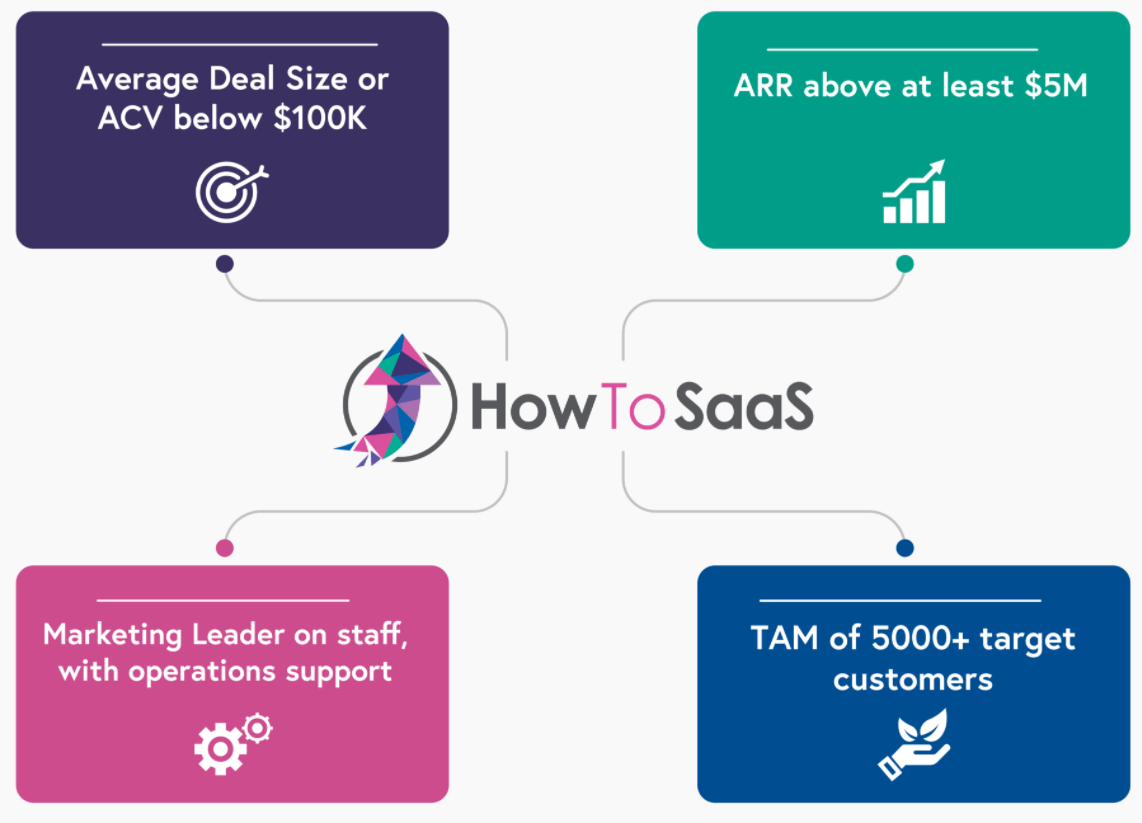
We work with high velocity SaaS companies, doing at least $5M in revenue, with a large TAM and an ACV below $100K.
Testimonials for How To SaaS

Michael Libert
SVP, TA Associates
“We always pull in the How To SaaS team into our portfolio companies where demand gen is core to our investment thesis.”

Bryce Youngren
Managing Partner, Polaris
“The How To SaaS team is my first call when my investments need help with digital marketing."