
SaaS Marketing Simplified · Chapter 1 of 10: Pitfalls and Mistakes
What are the most common SaaS marketing mistakes, and how do you avoid them?
By Shiv Narayanan, Founder & CEO of How To SaaS
Most marketing problems in SaaS companies trace back to a handful of avoidable mistakes, from investing too late to spending on channels that don’t produce pipeline. This chapter covers the most common pitfalls and what to do instead.
Drawing 1
Delayed Marketing Investment
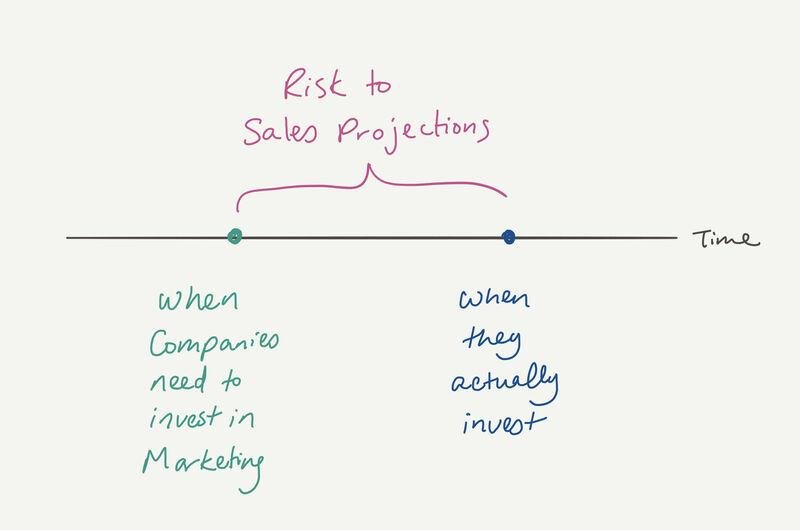
There is often a gap between when companies need to invest in Marketing and when they actually do it. This puts Sales projections at significant risk.
If you need a certain amount of Marketing support to hit your projections for the year, that investment needs to be made likely in the previous year so buyers have time to make it through their sales cycle.
That means that if you start scaling up your marketing spend at the end of Q1 or the middle of Q2, you're already likely to miss your targets.
This includes doing the following ahead of time:
- Hiring people: A hire you make in Q1 won't be fully ramped up to contribute until Q2 at the earliest. An open job posting in Q1 is even further out from contribution.
- Ramping up ad spend: To generate more deals, you need to generate more Marketing Qualified Leads (MQLs), which likely means you should have ramped up ad spend a long time ago.
- Scaling content production: To publish more content that generates demand with meaningful pipeline contribution, you need to have a content roadmap and a team executing against it in place months before.
All of the above means securing budget well ahead of a December board meeting or a January sales kickoff. The sooner you get going, the higher your odds of success. ‘Sooner’ often means ‘a quarter earlier’ if you’re going to achieve the ultimate goal of scaling Marketing efforts: driving revenue.
Drawing 2
Mistakes of Fired VPs of Marketing
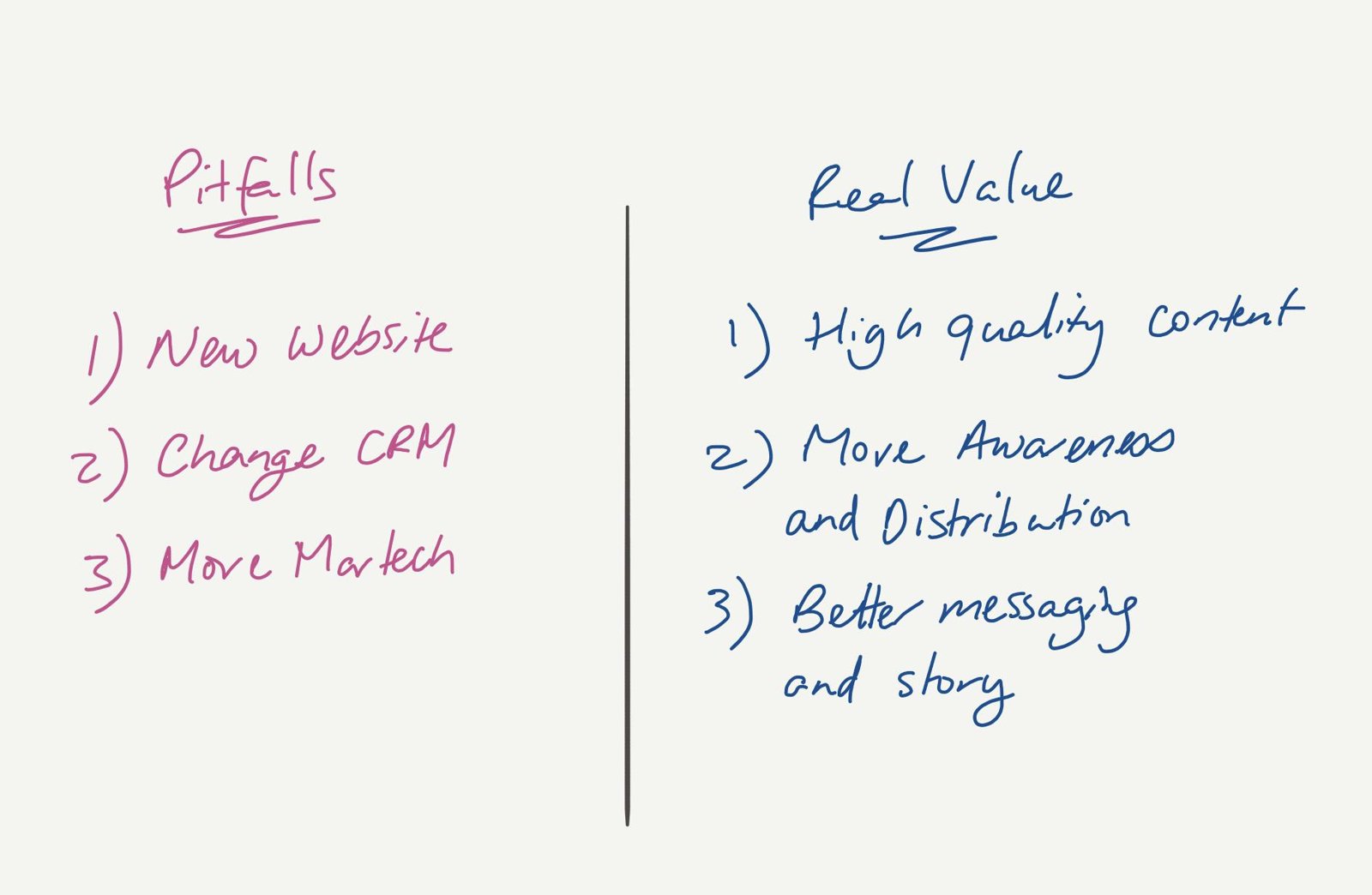
The most common reason VPs of Marketing/CMOs are fired in their first 12-18 months is that they blow their political capital on things like:
- Building a new website
- Changing the Customer Relationship Management system (CRM) they use
- Adding more tech to their marketing stack
None of these things actually do what the marketing leader is hired for: grow demand.
What VPs of Marketing should focus on in their first few quarters on the job:
- Nailing doing messaging and positioning
- Creating more high quality content
- Ramping up demand gen across all platforms
The end goal of all of these is to generate more pipeline and close more deals.
For bonus marks: improve data tracking and board reporting (this doesn't matter if there isn't more pipeline to report on).
Drawing 3
Air Cover
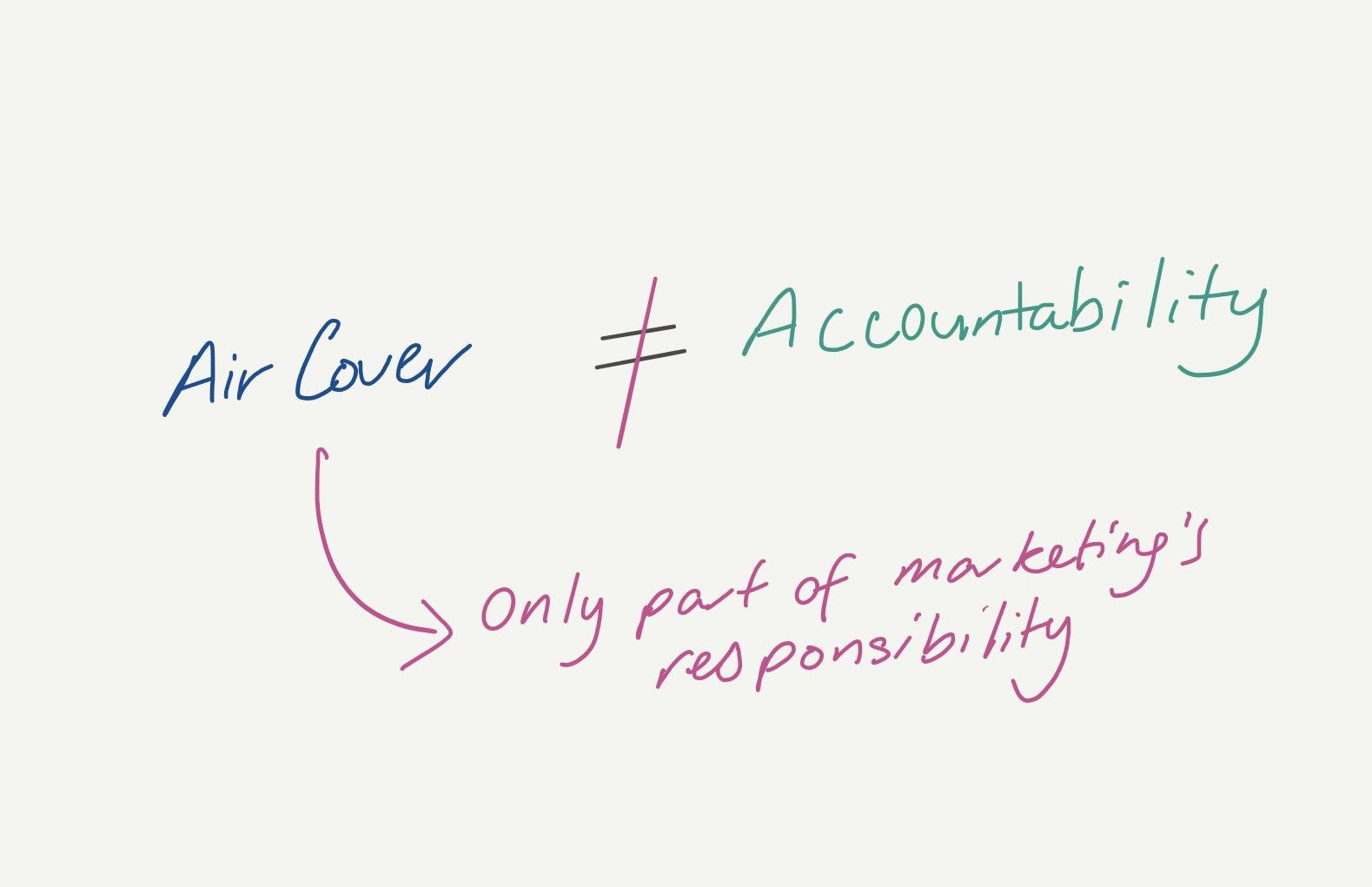
"Our campaigns provide air cover" is one of the most commonly-used marketing excuses in the book.
It's also the excuse that Sales and the rest of the organization rolls their eyes at — especially at times when the company is missing targets.
Air cover is used as a shield by marketing organizations that aren’t accountable to revenue. While air cover is important, it’s not the only thing Marketing is responsible for.
A marketing function that washes its hands clean of revenue accountability is not a true marketing function. It’s closer to a corporate marketing sub-function of a bigger marketing need inside an organization. If Marketing isn’t revenue accountable, it’s almost impossible to work in alignment with Sales, and you can expect valuable potential deals to fall through the cracks.
Instead, leverage air cover to get your sales team more support when they enter a sales conversation. But you should also leverage other marketing activities like content, demand gen, social and more to build trust with buyers and generate more sales.
When Sales and the rest of the organization notices you taking full accountability of revenue, they also take Marketing more seriously.
Drawing 4
Stop Spending on Bad Channels
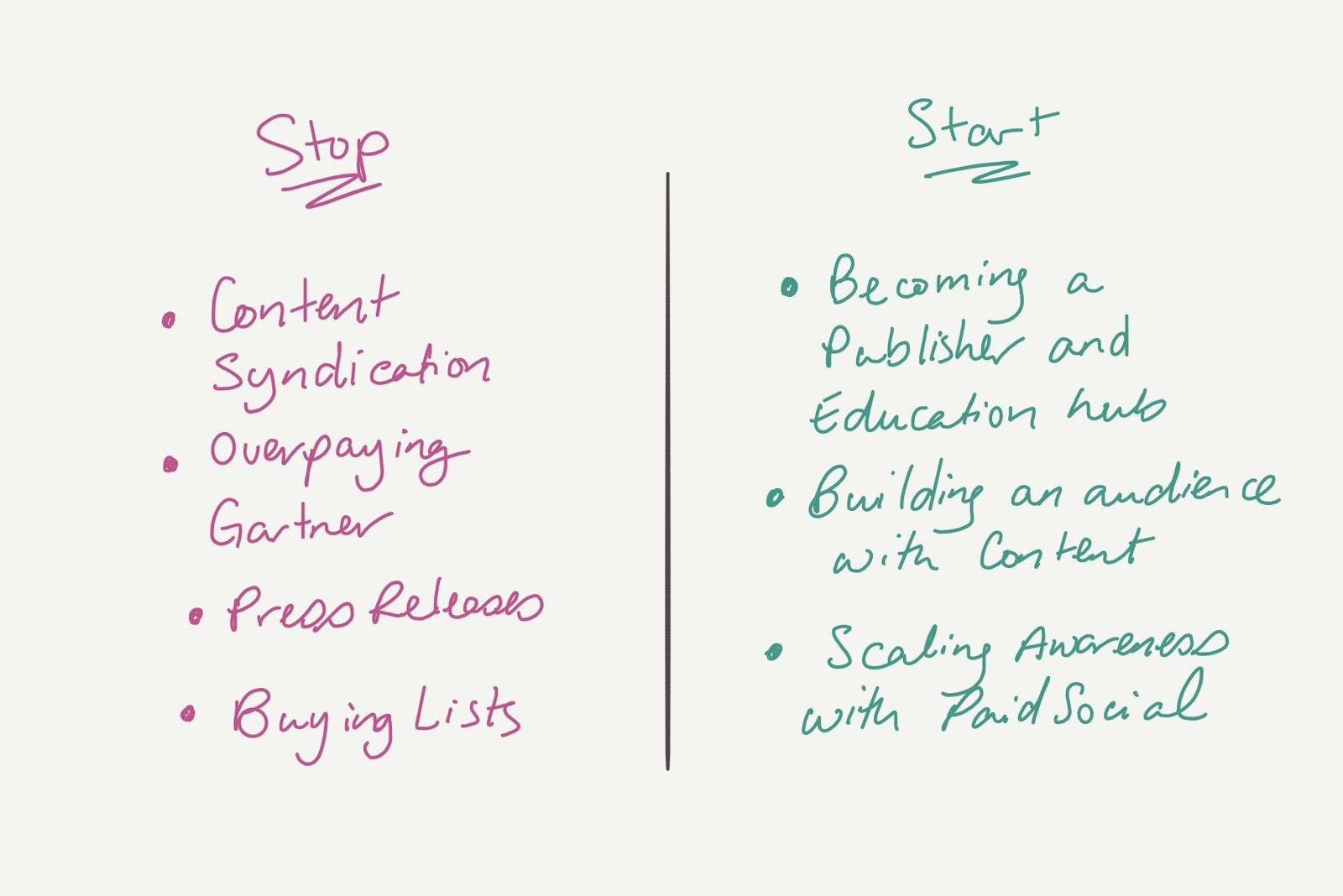
Marketers often complain about a lack of budget, yet the same marketers invest significant portions of their limited resources into things that don't work.
These include:
- Content syndication
- Overpaying Gartner
- Press releases
- Buying lists
Instead, look at how much of your marketing budget is going into these kinds of activities that produce virtually no impact on revenue.
Sure, things like content syndication raise awareness on broad channels, but in most companies the impact on revenue is small (with or even without attribution).
Instead:
- Create a strong point-of-view for your business, prospects, customers and market.
- Produce phenomenal content to become the go-to resource your customers and market learn from.
- Increase distribution to your ideal customers through targeted efforts.
Same marketing budget, entirely different impact on revenue, profitability and enterprise value creation.
Drawing 5
High ROI Marketing Activities
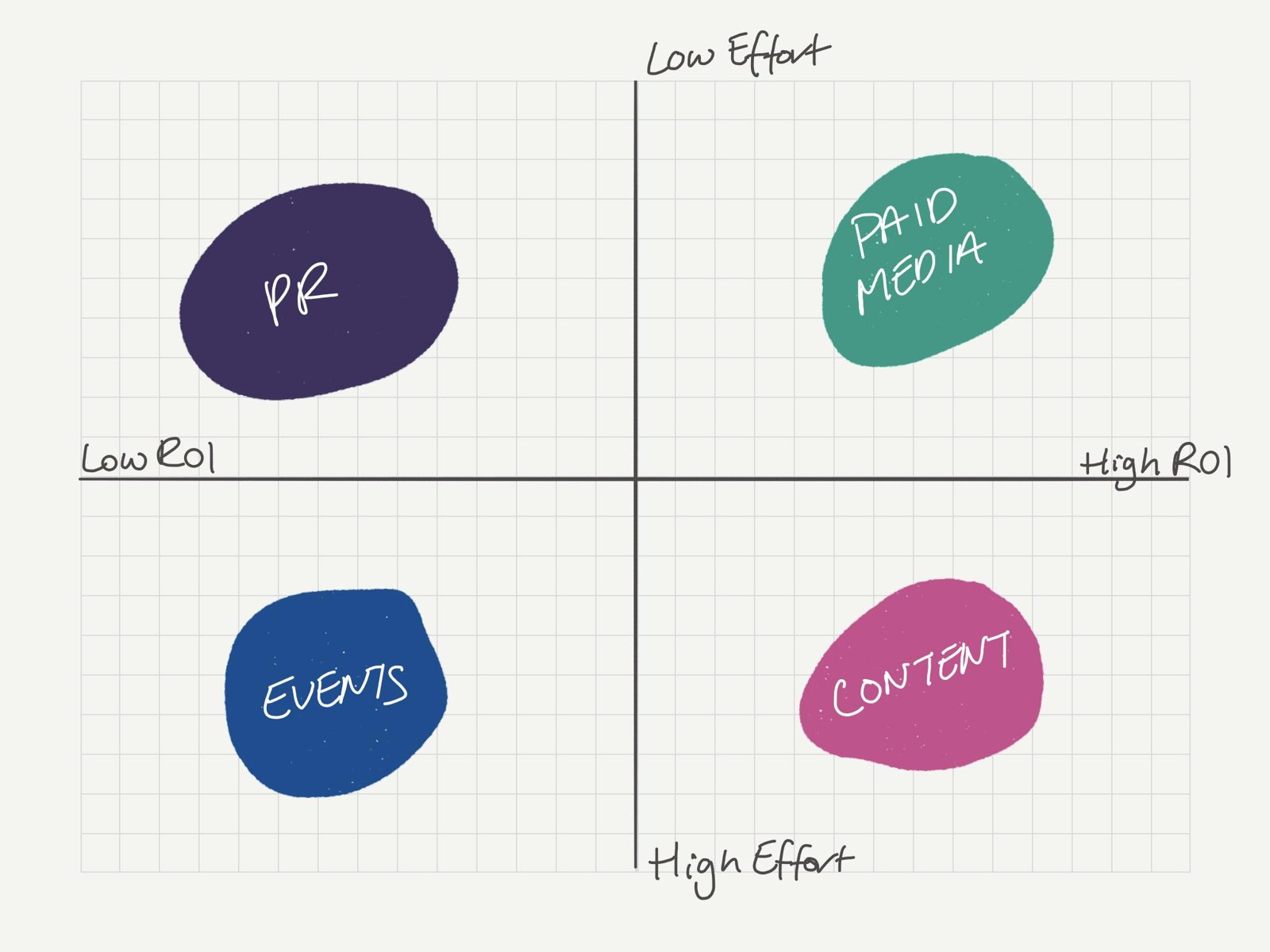
The marketing budgets of so many companies are shockingly upside down.
In many cases, activities like events and trade shows that have huge upfront investments and low return on investment (ROI) get more than half the marketing budget. The same companies will put out a press release (that no one really reads in today's world anymore) every time something happens.
Meanwhile, areas like paid media and content are heavily under-funded, despite their potential to deliver high ROI.
The result? Marketer leaders often end up standing in front of the board, trying to ask for more budget, even though they’re underdelivering on revenue targets.
Granted, low effort/high ROI paid media campaigns will likely attract many competitors as well. But they're a heck of a lot better than spending $25,000 on a booth + travel and expenses for 10 people to go to an event where every competitor has a booth as well.
Content is the blue ocean opportunity — most competitors don't venture here because of the effort required. To consistently produce useful content, you need to be willing to invest time and resources. It isn’t easy — it takes talent and expertise to emerge as the winner when publishing content in your industry. But it’s also where the asymmetric returns exist for most companies.
Drawing 6
Tech Stack vs. CMO Tenure
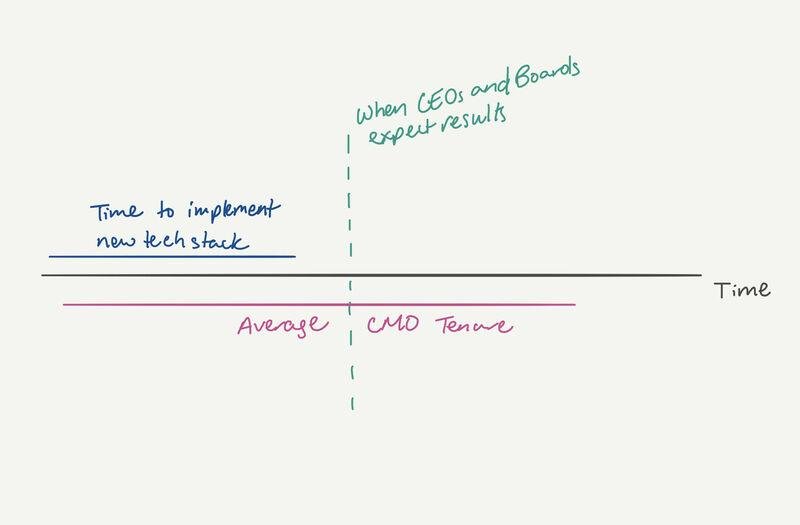
There is an inherent mismatch between implementing a new Marketing tech stack and how much time you have as a Marketing leader.
While the latest account based marketing (ABM) or attribution or content (etc.) platform may sound like a phenomenal idea, it is more than likely setting up Marketing leaders everywhere to fail in the long run.
The reason? Tech stack implementations take a lot of time, effort and energy. Meanwhile, the company still needs to hit sales targets and likely isn’t generating enough pipeline.
These Marketing leaders find themselves in board meetings for several quarters in a row talking about the new programs they’re "going to launch" once the platform is live. Over time, this erodes trust with CEOs and boards until they change marketing leadership
Instead, Marketing would be much better served by focusing on executing plays that generate pipeline and revenue. This builds enough political capital to buy you the time it takes to implement a new technology.
This is something Martech vendors will never tell you:
- You can run a good enough ABM program without Terminus/6sense.
- You can run good enough attribution without Snowflake, Tableau or a data warehouse project.
- You can run good enough paid media without Acquisio, Wordstream or AdRoll.
Focus on the execution and you'll go a lot farther.
Drawing 7
Marketing-Led Budgets
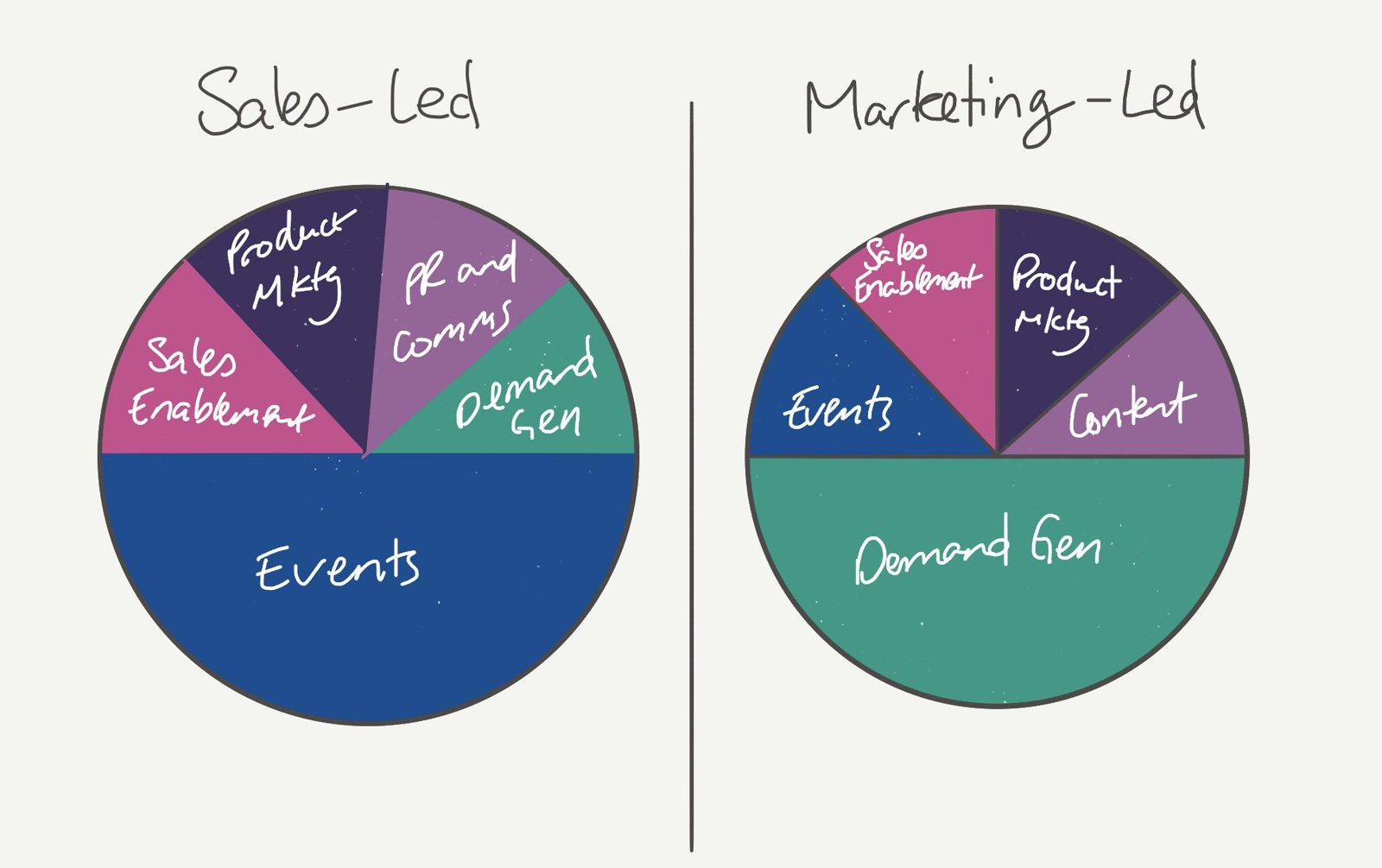
Looking at marketing budget splits by activity tells you a lot about marketing organizations.
Sales-led organizations put a heavy focus on traditional marketing activities like events, sales enablement, PR and comms. These activities are often resource-intensive, and usually focus on objectives like brand awareness or relationship building.
Marketing-led organizations put a heavy focus on demand generation and content. There's still room for the traditional marketing functions, but the focus on revenue is clear.
Shifting from a Sales-led function to a Marketing-led function does not imply adding additional budget. It can simply involve refocusing the same budget and allocating it towards revenue-driving activities.
Drawing 8
Expensive SKOs
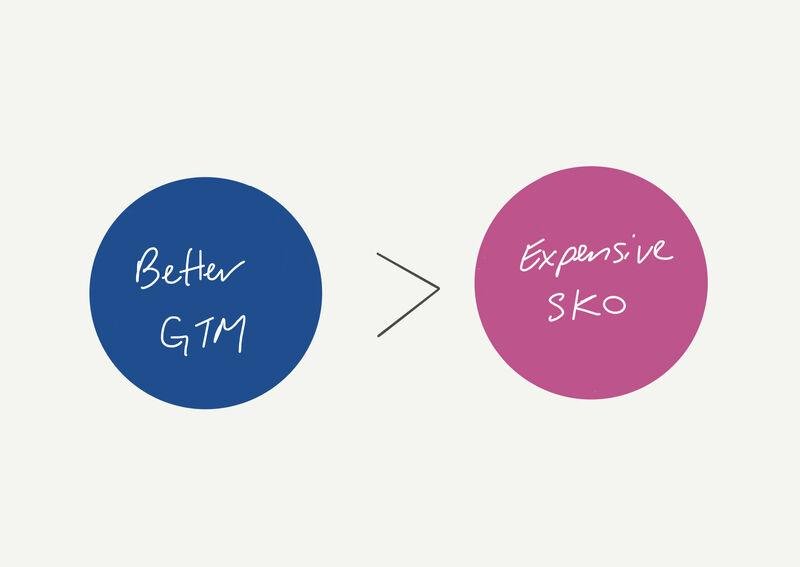
Sales-led companies are notorious for spending hundreds of thousands of dollars on expensive sales kickoffs (SKOs) to start the year.
SKOs certainly serve a purpose to educate and enable sales reps to sell more/better. But the messaging inside these events often resorts to old school sales platitudes like:
- "Pound the pavement"
- "You can crush your targets"
- "Keep dialing for dollars"
Meanwhile, the company's Go-To-Market is weak. The overall company narrative and story don't resonate with customers and prospects. There isn't enough content to educate prospects along their journey. There aren't enough demand generation programs in place to produce inbound MQLs.
Even if the SKO helps make Sales more effective, that doesn’t count for much if Marketing isn’t in a position to be able to deliver more MQLs or support the sales process.
As a growth leader, your job is to build a better Go-To-Market that shapes the SKO — rather than the other way around.
Drawing 9
Marketing Reporting to CRO
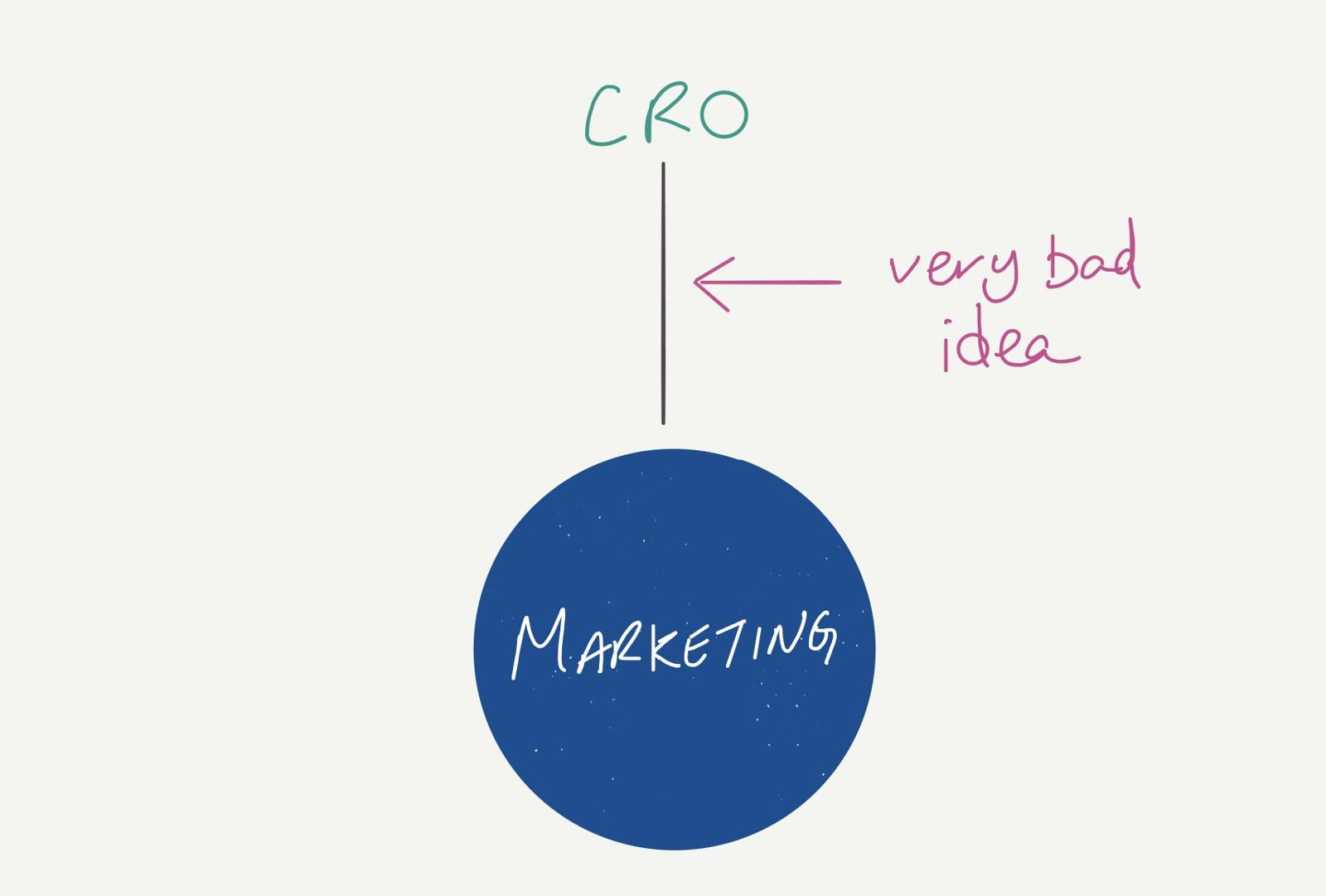
Marketing reporting to the Chief Revenue Officer (CRO) is one of the worst ideas generated inside the hierarchy of so many organizations.
"By having marketing report to the CRO, we have one revenue organization" — this is the most common reason cited for the blunder.
The big error in this thinking is that the CRO is often a sales leader who defaults to sales thinking when it comes to critical marketing decisions. This is a recipe for disaster.
What would a sales-leaning CRO choose: hire one more sales rep or increase the marketing budget? The likely answer is a sales rep.
Having Marketing report to a CRO also creates a layer of bureaucracy between Marketing and the CEO — the person who you ultimately need to increase marketing impact.
By having Marketing report to a CRO or VP of Sales, the CEO foregoes:
- Taking charge of the brand narrative and story
- Connecting to the market and customers
- Understanding and balancing the investment in Sales and Marketing
- Giving Marketing the right budget
There are a few rockstar CROs out there who can lead both. But they are in the minority by a country mile.
Marketing needs to report to the CEO. Otherwise, Marketing doesn't have a seat at the table and the organization continues to be sales-led. Be wary of any org structures that obstruct this.
Drawing 10
Raw Marketing Skills
Too many companies pass up on high-potential marketing candidates due to a lack of experience.
Over-indexing on experience can lead to a lot of expensive hiring mistakes. Sure, a candidate might have worked on high-profile campaigns with a big-name employer, but if they don’t have great communication skills, you’ll likely be going through the hassle and expense of replacing them within six months.
There’s just not enough marketing talent out there to supply the demand / need from companies looking to hire for those roles. Instead, focusing on raw skill sets and committing to leveling up those individuals so they can eventually fill the shoes of a bigger role can lead to enormous success.
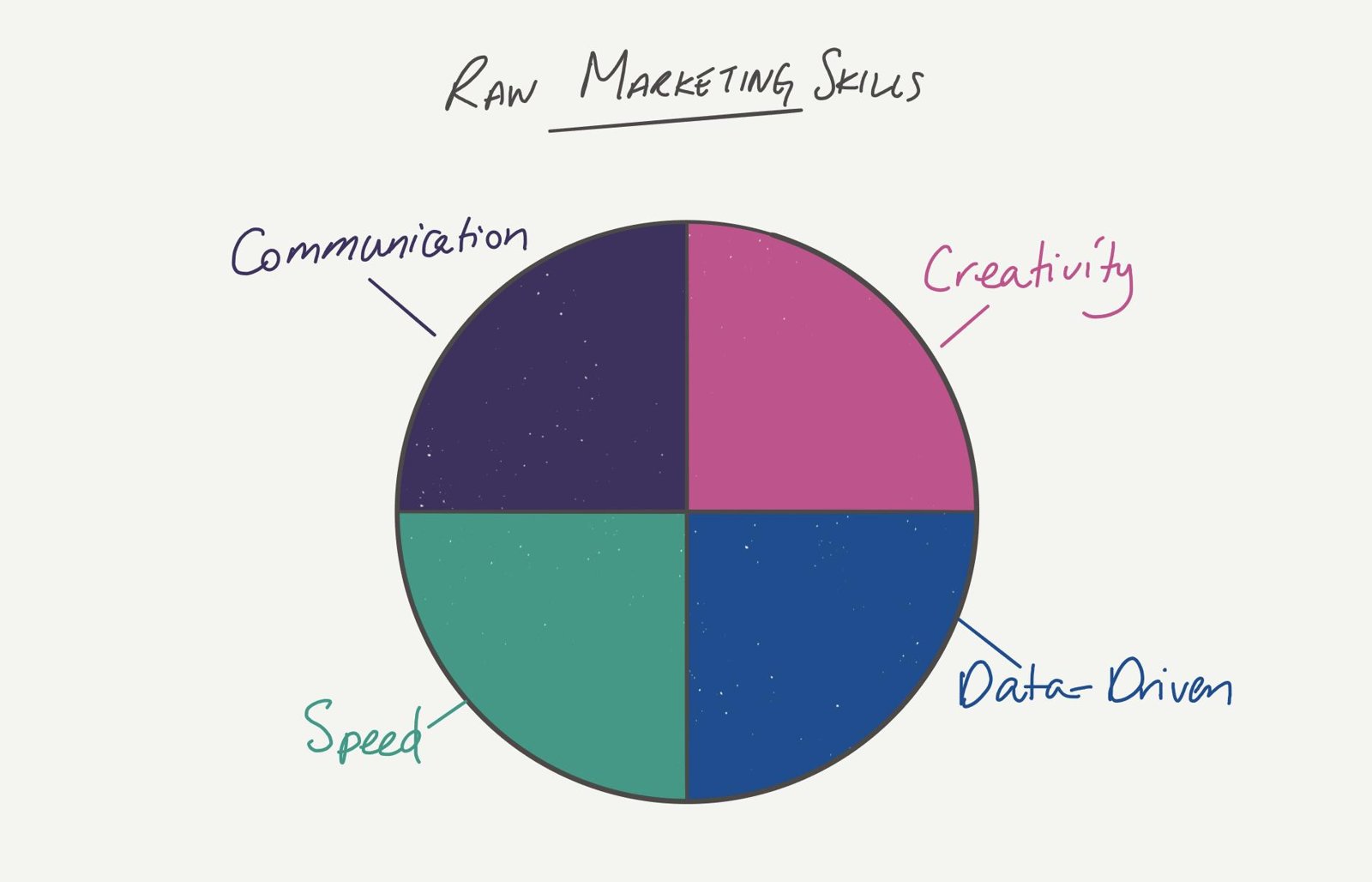
Raw skills to look for:
- Communication: Written, verbal, presentation skills, ability to manage expectations.
- Creativity: Thinking outside the box, being able to bring personality — to the brand, to programs, and the team culture.
- Data-driven: Inclination to look at metrics and performance as positive feedback loops.
- Speed: High rate of quality output and an ability to pick things up about the industry / technical skills
This applies whether you’re a startup looking to attract a talented Director of Marketing or if you’re a well-established company looking for a Marketing Manager. Think of your company like a sports franchise drafting young players.
Hire for potential. Then invest in the talent to reach its potential. That’s how everybody wins.
Want to talk through how this applies to your business?
Book a time to speak with our team.