
SaaS Marketing Simplified · Chapter 3 of 10: Customers and Market
How do you find and focus on your best-fit SaaS customers?
By Shiv Narayanan, Founder & CEO of How To SaaS
Growth starts with knowing exactly who you serve and how they buy. This chapter covers how to find and focus on best-fit customers, use their voice to shape your positioning, and avoid chasing the wrong part of the market.
In this chapter
Drawing 18
How customers buy
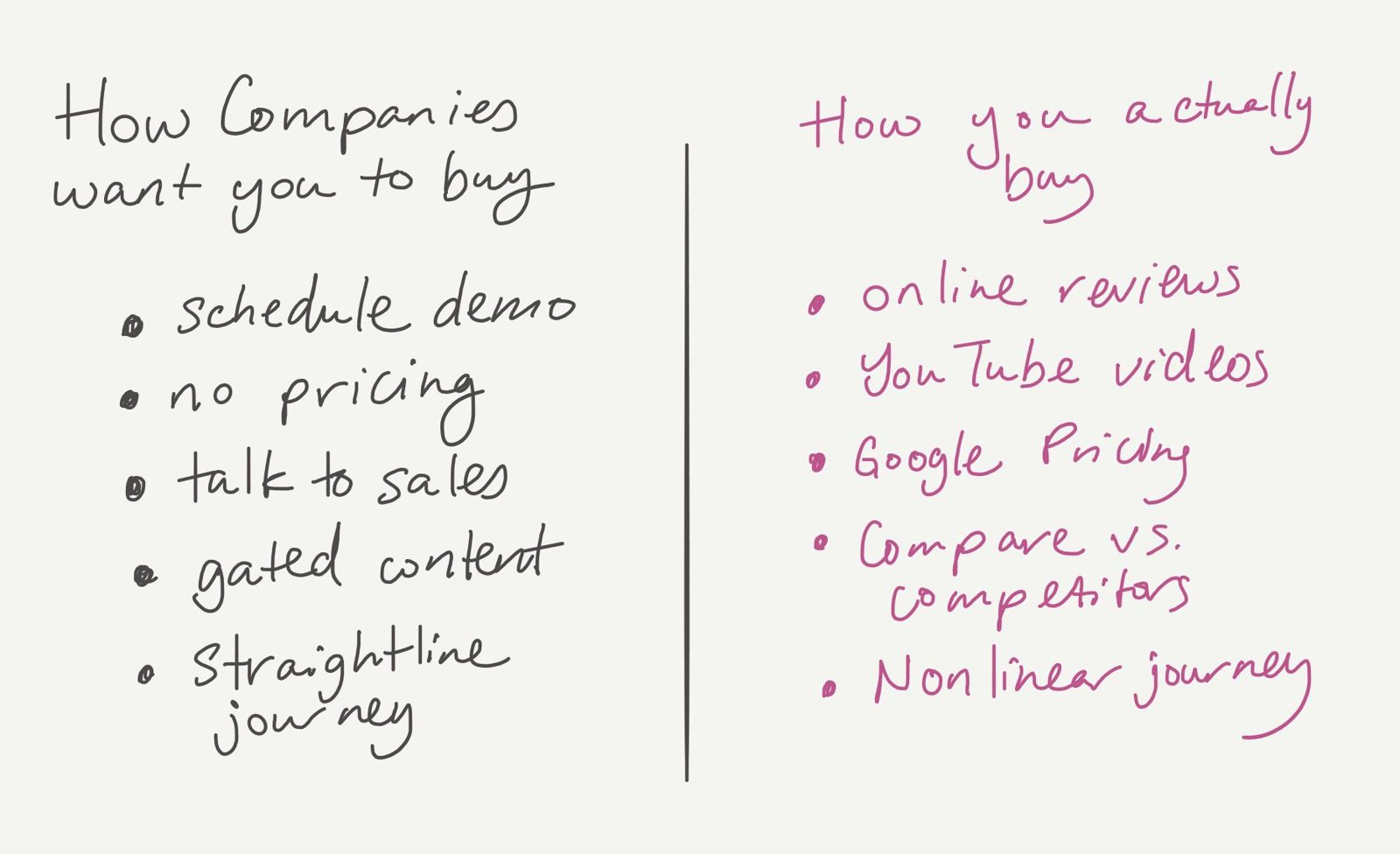
There is a big disconnect between how companies want to sell to customers and how customers actually want to buy.
No customer wakes up wanting to go through your perfectly crafted, straight line buyer journey.
Meanwhile, companies are trying to push you through so many hoops, gates and forms just to trigger the right lead scoring. These companies also avoid talking about competitors because they assume you won't find them for yourself.
Best case scenario: a customer somehow makes it through your digital assault course and lands in a sales conversation, but they’re frustrated and not inclined to give you their money.
The more likely scenario: they give up on trying to find what they need and go with a competitor.
Here's the thing: your customers don't care about the journey you made them. They'll:
- Find pricing on Google
- Look up competitors on Capterra
- Watch your pre-recorded demo on YouTube
- Read a bunch of reviews on TrustPilot
- Ask people they already know
All of this is happening without your lead scoring being triggered.
Change the internal company dynamic. Focus on helping the customer at every step with as much content as possible.
B2B marketing would be a heck of a lot better if marketers approached it the same way they themselves do when they buy headphones from Amazon.
Drawing 19
Pains vs. Dreams
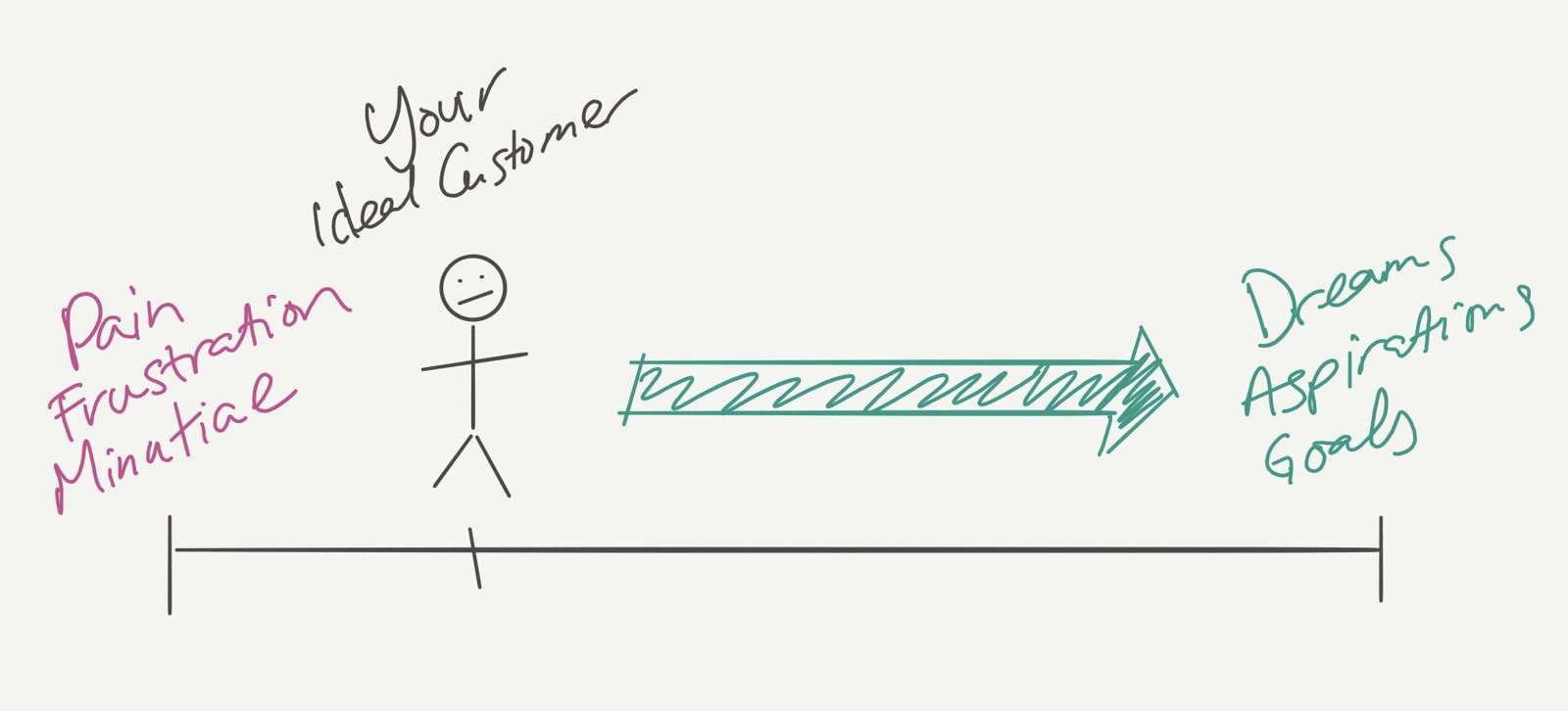
Marketing and sales become a whole lot easier when you know your product can move people further away from their pains and closer to their aspirations.
Customer pain points and how to solve them should:
- Inform your product roadmap
- Be part of all the content you produce
- Be one of the first things people notice on your website
- Instruct key decisions on growth strategy
- Be front and center in your sales conversations
If you build a culture where people are obsessed with helping your ideal customer navigate this journey, you will build a winning company.
Drawing 20
Solve for One Customer
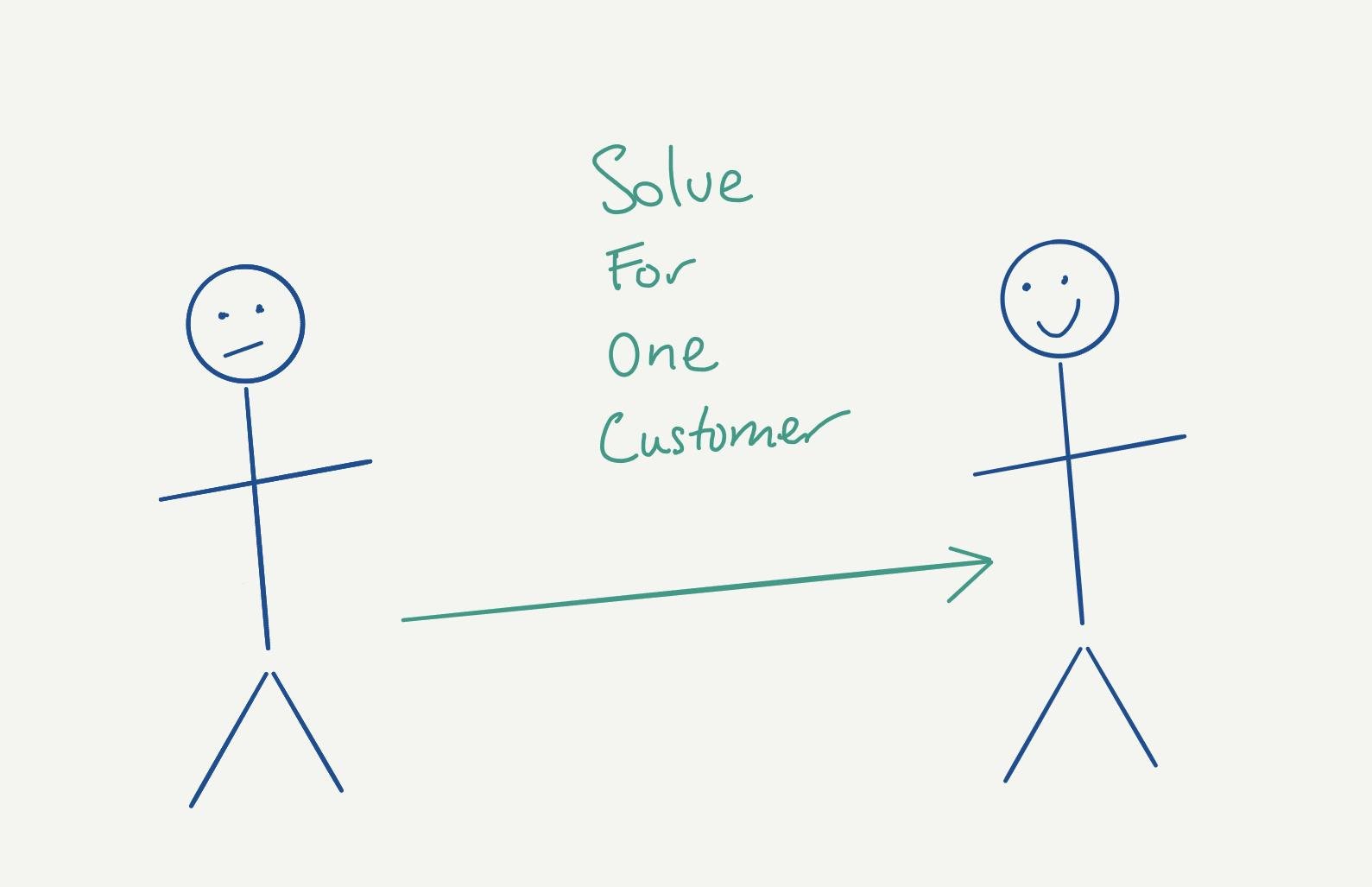
To drastically increase the odds of success, focus your company efforts around resolving the pain points of one customer.
When you’re dealing with huge generalizations (e.g. everyone who works in HR, all content producers), it’s almost impossible to speak to individuals in a way that resonates with them.
At the end of the day, buying decisions usually come down to an individual who either makes the call themselves or promotes the product to their team. And if that individual doesn’t feel seen or spoken to, they won’t be convinced.
The best way to really get to the core of why your product matters, why someone would spend money on it, and why they would advocate for you is to understand what it means for people on a personal level.
This is why some of the biggest companies started by people trying to scratch their own itch (e.g. Basecamp).
An effort like this involves:
- Product teams clearly defining the person they need to solve problems for with all existing and roadmapped features.
- Service teams clearly identify how to support new and existing customers on their journey.
- Sales teams clearly mapping out the ideal buying persona and targeting them with focused outreach.
- Marketing teams clearly outlining the messaging, content and distribution required to reach that ideal persona.
Focusing on one specific person may seem like it has a huge opportunity cost. But the market size of solving a very specific problem for one specific person is almost always a lot larger than you think. This exercise also opens up adjacencies that were previously invisible.
Drawing 21
Customer Obsession
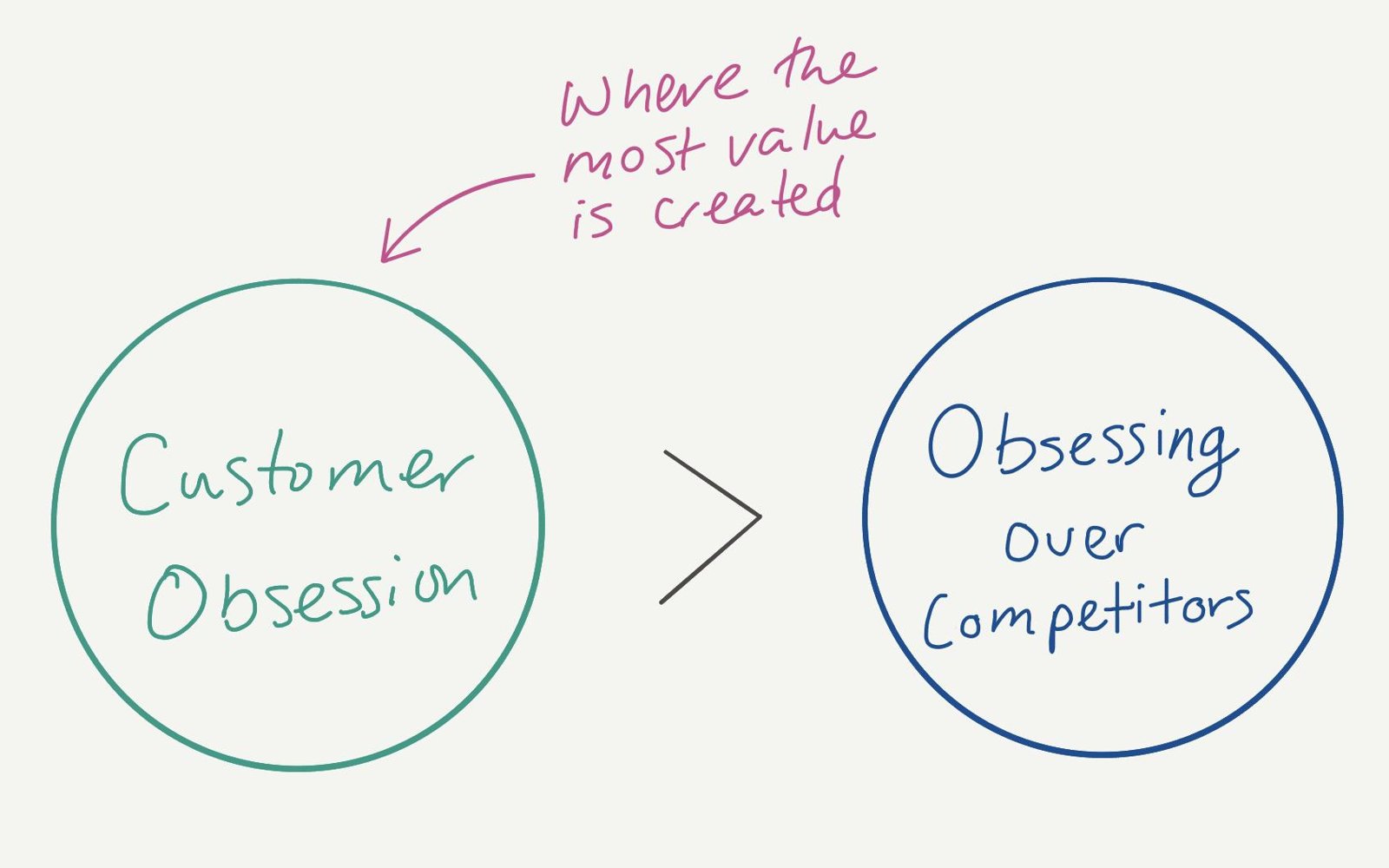
Too many companies obsess over what their competitors are doing, which feature they've released, what their product looks like and how they're marketing it.
This obsession inevitably leads to the commoditization of products and businesses, neither of which has a real differentiator.
What if you focus on your customers and what they're telling you instead? What if you think about how you want to serve them differently?
Notice I said ‘differently’, not ‘better’.
Everyone wants to be better than their competition. That's how the obsession with competition begins. But in an infinite game, ‘better’ is irrelevant.
As a marketer, you need to obsess over your unique way of serving customers. They’ll see the value your solution brings, and you'll get farther than you ever have.
Drawing 22
Customers Lead Content and Demand Gen
Marketers who over-index on search engine optimization (SEO) or paid search often (incorrectly) rely on ‘search volumes’ and ‘keyword difficulty’ as their guide on what to prioritize.
This leads to companies fighting for market share like a commodity, inevitably inflating CAC and Payback Period metrics.
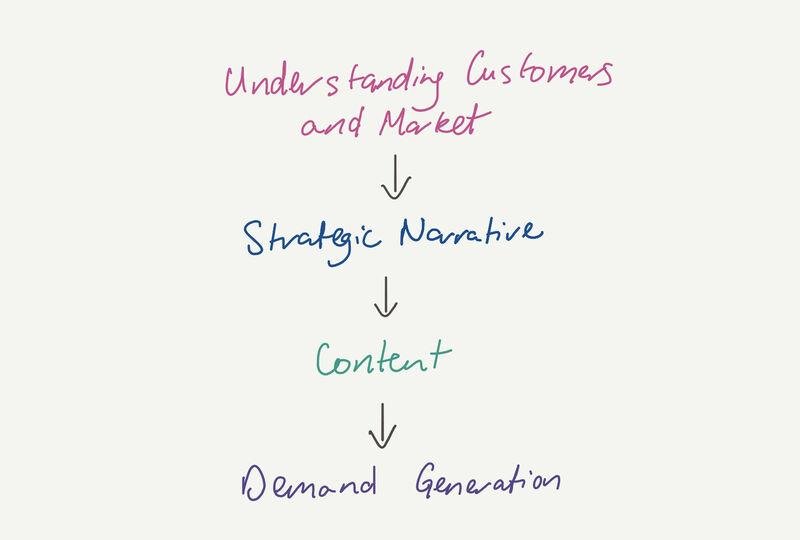
Instead, starting with differentiation as the goal changes how you go to market:
- You invest heavily into understanding market dynamics and customer pain points.
- You build a strategic narrative to educate the market on how to resolve those pain points while separating yourself from the noise.
- You create content to educate buyers on the strategic narrative at every stage of their journey.
- You leverage demand generation channels and campaigns to scale content distribution to your ideal buyers.
This approach focuses on the customers and the message, rather than search volumes or keyword difficulty.
It brings down CAC and improves your Payback Period.
It also opens up infinite scale because you can take the message to any channel — not just channels where search volumes are the focus.
Ironically, this approach also leads to far more uptake from the market, which helps improve SEO and paid search performance over time anyway.
Drawing 23
NPS Promoters
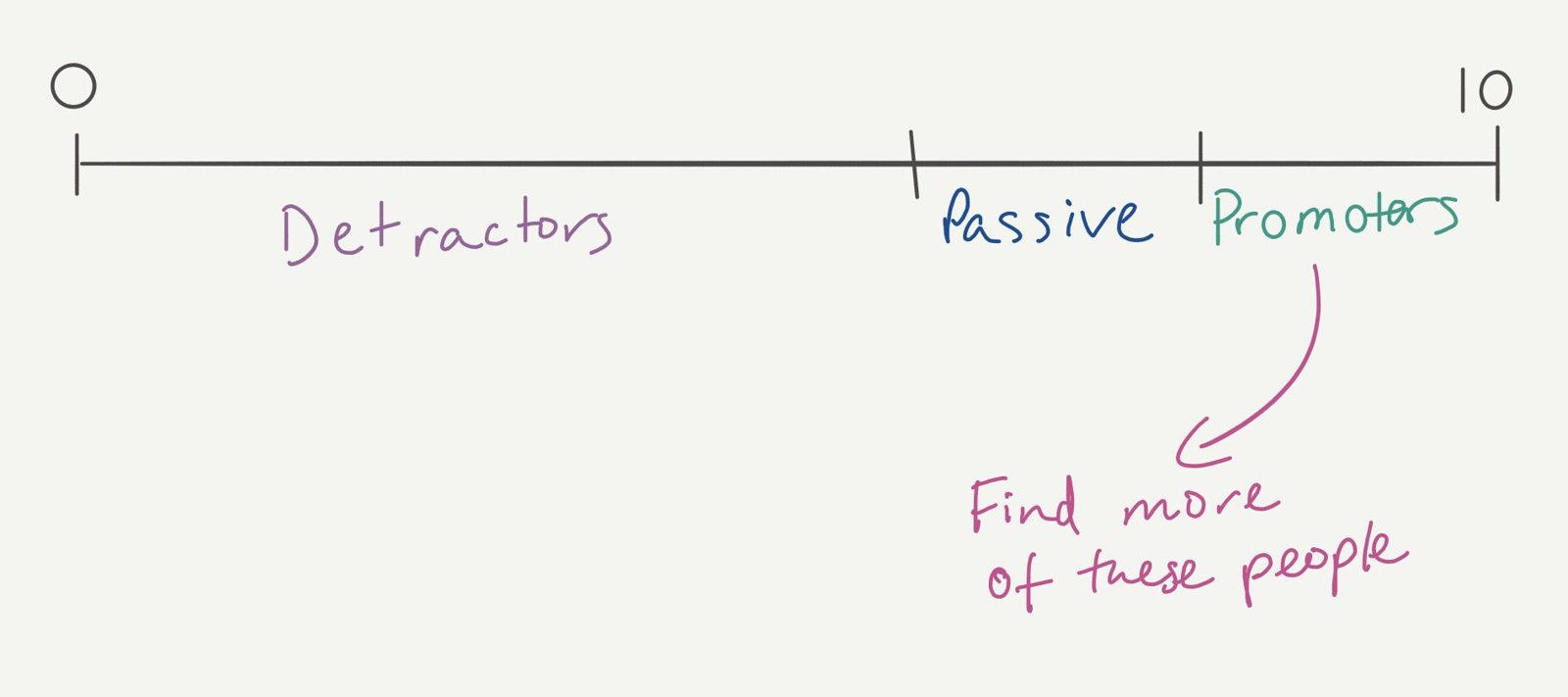
Identifying who loves your product is critical to directing where you invest marketing dollars. What good is a Closed Won deal if the customer you bring in hates using your solution or churns in 120 days?
This is why marketers need to make a conscious effort to connect with their product teams.
You need to:
- Understand who ends up being an NPS (Net Promoter Score) promoter for what you sell.
- Understand their characteristics. Are there underlying themes in industry, vertical, role, region, size, pricing plan, etc.?
- Refine your Total Addressable Market (TAM) — maybe some of your identified markets aren’t ideal for your solution after all.
- Go back to your marketing efforts and adjust to focus on the best fit customers.
- Repeat.
This is how Marketing shifts from a one-size-fits-all approach that tries to please everyone to focusing on people you know you can serve — and serve well.
Drawing 24
Best Fit vs. Bad Fit Customers
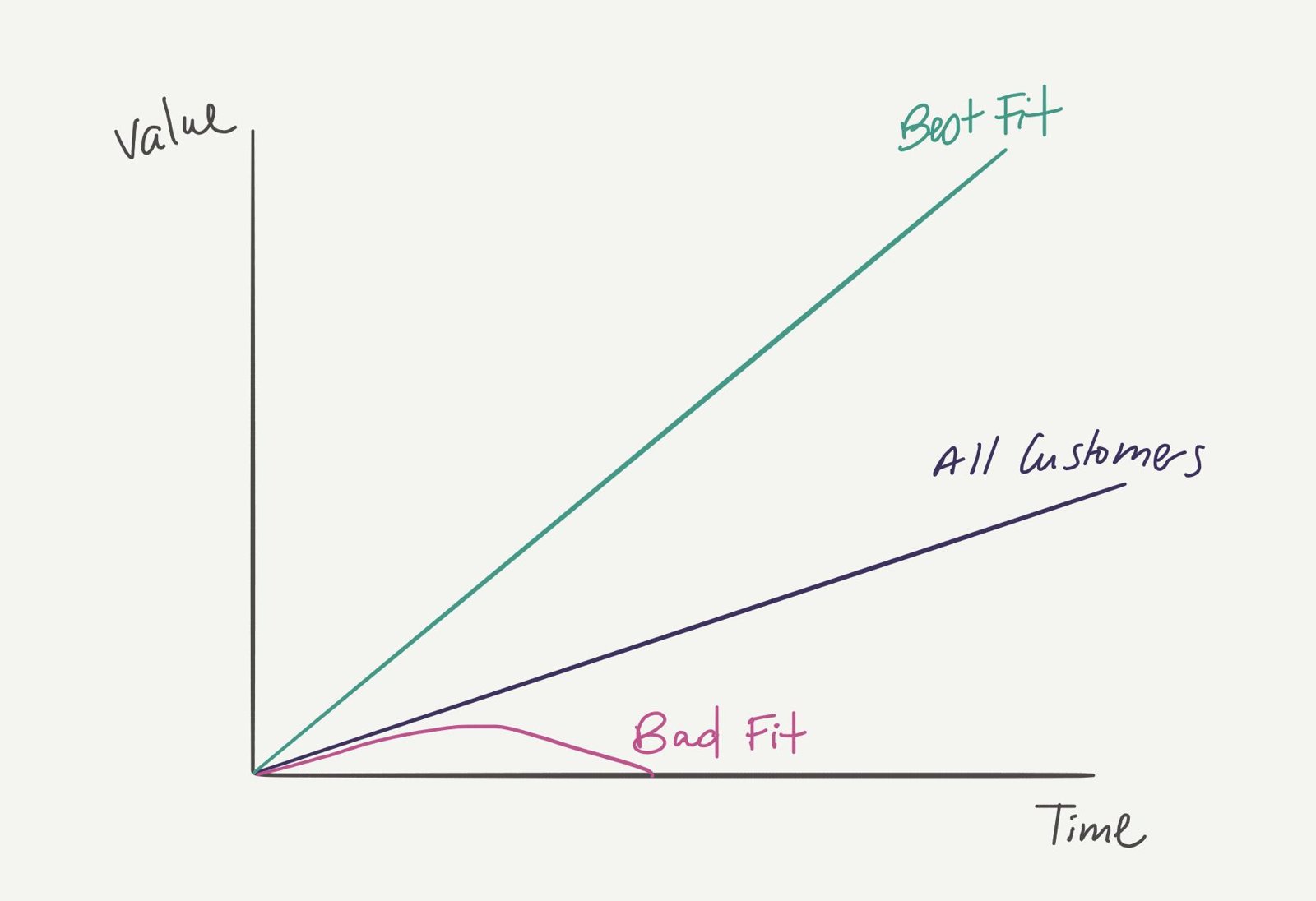
Your best fit customers are significantly more valuable than bad fit customers. They are also more valuable than your overall customer base (including those who are a good fit).
If you spend enough money and resources, you can convince even bad fit customers to buy. But because the product isn’t right for them, those customers will likely have a negative experience, leave after a few months, and share that negative experience with anyone who will listen.
Good fit customers, on the other hand, will:
- Cost less to acquire
- Stay with the business for longer
- Use the product more effectively
- Advocate on your behalf
That's why you need to tailor the following to your best fit customers:
- Product roadmap
- Demand gen
- Sales
- Content
- Onboarding
...and more
The more you focus on your best fit customers, the more easily you’ll build a differentiated position in the marketplace with super fans and power users.
Drawing 25
Engagement of good fit vs. bad fit
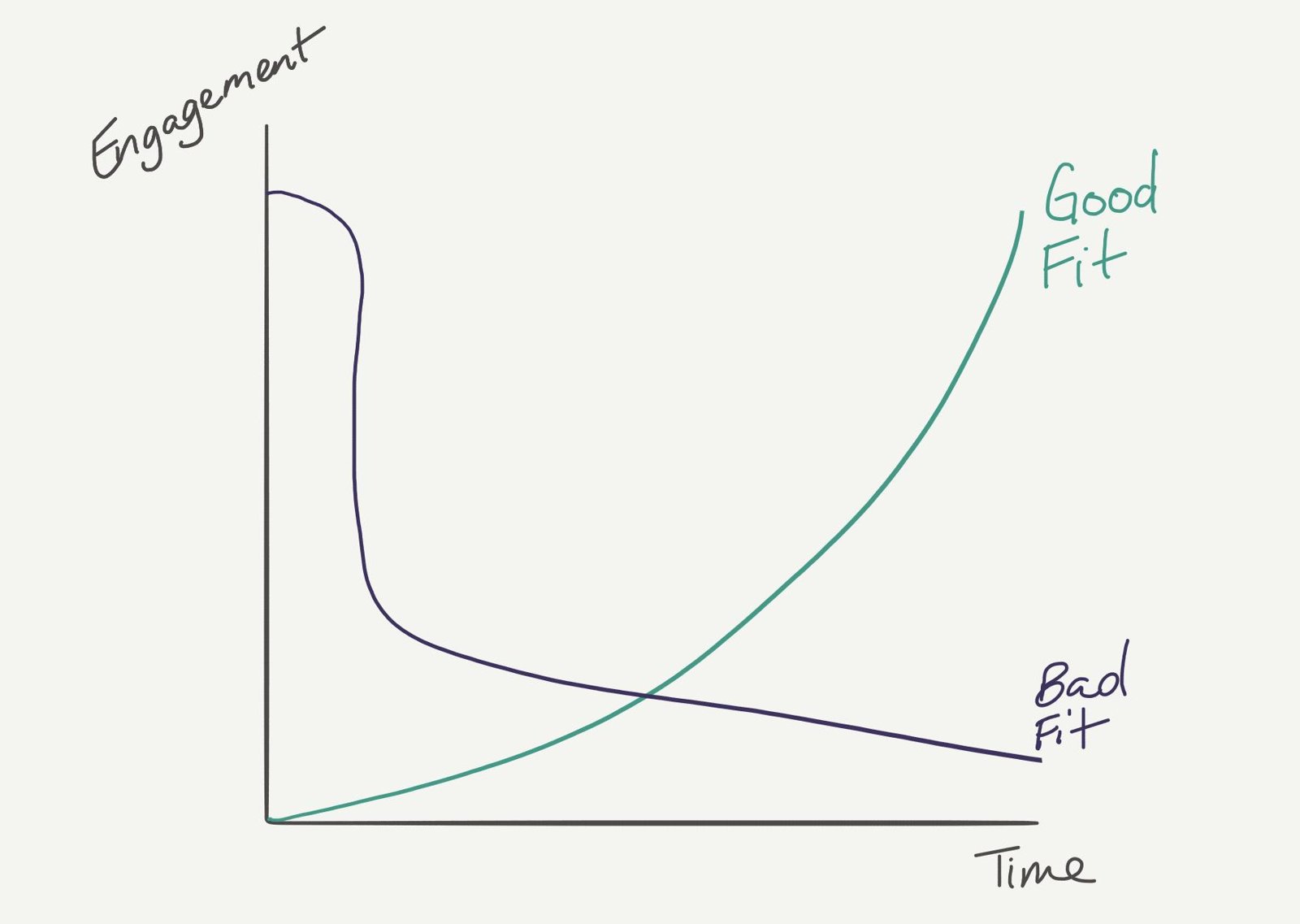
Good fit customers will increase their engagement over time. Bad fit customers’ engagement will fall off a cliff.
This is why you should not worry about decreased engagement as you scale your content and distribution.
Content or ad "fatigue" is often used as the argument against scaling to deliver more content, more emails, more touch points.
But your best fit customers want to hear more from you. You are solving a very real pain in their lives.
The more content you put out, the more helpful they will find you in resolving that pain. The more helpful you are, the more likely they are to buy from you.
This is why scaling content to infinite distribution works.
The trick is to leverage personalization and customization whenever possible. That increases engagement because you have dedicated streams for different segments of your market.
If you focus too much on the bad fit customers and their engagement, you'll get caught trying to be everything to everyone. Inevitably, you’ll end up wasting your budget on vague campaigns that don’t attract high-value customers.
Instead, focus on your best fit customers and don't worry about fatigue.
Drawing 26
Market vs. ICP Growth
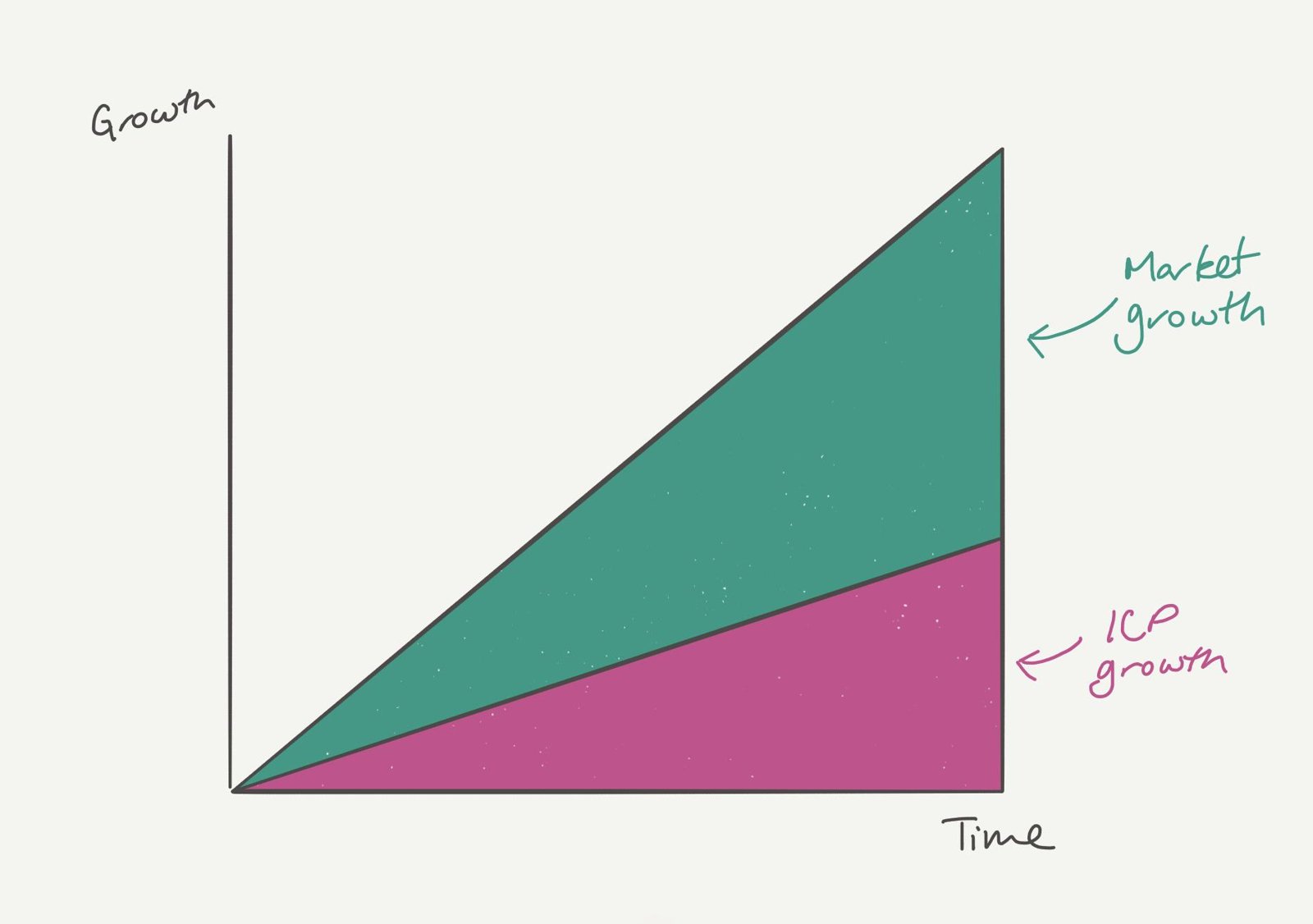
Focusing on a broader set of customers inevitably leads to an increase in the customers that fit your ICP.
Segmentation theory argues that you should segment your best fit prospects/customers and customize your messaging to those people.
While there is truth to this — especially in enterprise B2B environments where ABM is a lever — broader awareness marketing still has massive benefits:
- You inevitably reach your ideal customer profile (ICP) as you increase awareness of your business in a broader category. For example, Trello captures all types of organizations and functions by going after the broader project management space.
- You enable customers to identify additional expansion ICPs for the business — e.g. verticals and markets who your perfect segmentation strategy ignored.
- You grow the brand as more people know about you and refer you as a solution. The downside is that your CAC increases as you go after a broader market, so this needs to be managed.
Even in environments where the TAM is super small, there needs to be an element of your marketing that goes broad to increase your market presence.
If you limit your marketing to ABM efforts simply because your TAM is small, Marketing's impact on revenue will also be limited.
Drawing 27
ICP vs. Search Volume

Too many companies start their GTM planning based on search volume instead of their ideal customer profile.
If a term receives 10 searches a month, search-driven marketers will put off creating content assets around that term. This is the classic hammer looking for a nail scenario.
In a world drive by Google Search, this approach has some validity. But we don't live in a search-driven world.
When you start with ICP, you build content based on what will help your ICP resolve their biggest pain points. Only then can you think about distribution. And when I say ICP, I mean all variations of your ICP.
Internal customer profile and journey work uses generalizations that put customers into buckets that don't exactly fit who they are. This is how companies end up finding customers who are using their products for completely different purposes than initially forecasted.
Some of those use cases end up being a massive growth lever for businesses, if only the business takes the time to understand the subset of the ICP that needs that problem solved
This is why analyzing all the true variations of your ICPs is important. Each variation has differences in terms of:
- How big the market is
- Where they can be acquired
- What the margin on landing the customer is
- What their LTV is
Once you understand these variations, you can unlock the growth potential of a business. And in a social-driven world where search volume is not the north star, GTM planning can then focus on finding the right channel/platform where you can find the ICP with the right message.
Drawing 28
Positioning Feedback Loop
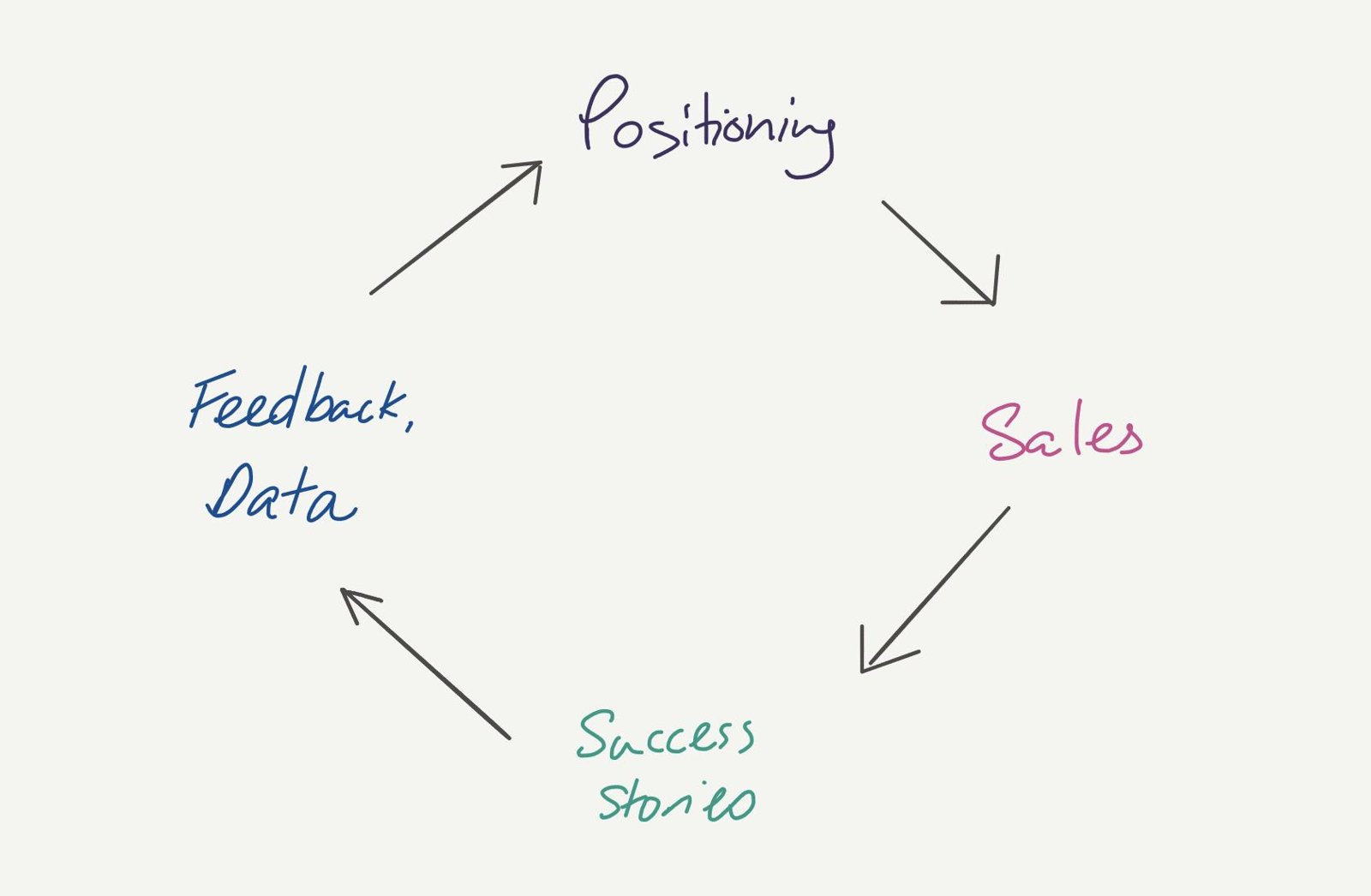
The best companies don’t treat positioning as a one-time exercise with an end point. Products develop and buyer pain points change, so if your positioning is stagnant, it won’t continue reaching the right people with the right messaging.
Instead, the best companies treat positioning as an ongoing, ever-evolving loop influenced by their market and customers.
Each time you tell your company's story, you find more prospects and close more deals. Each cohort of customers reveals additional information about:
- Which types of customers are an ideal fit
- Who has most success with the product
- What type of messaging resonates with those customers
- Which pain points the product still fails to address
- What other solutions those customers are looking for
As you uncover more information, you need to feed it back into positioning to change the overarching story around the company/brand.
With every cycle, you’ll find more scale because you uncover more opportunity — e.g. a greater TAM or higher LTV.
Drawing 29
Secret Sauce
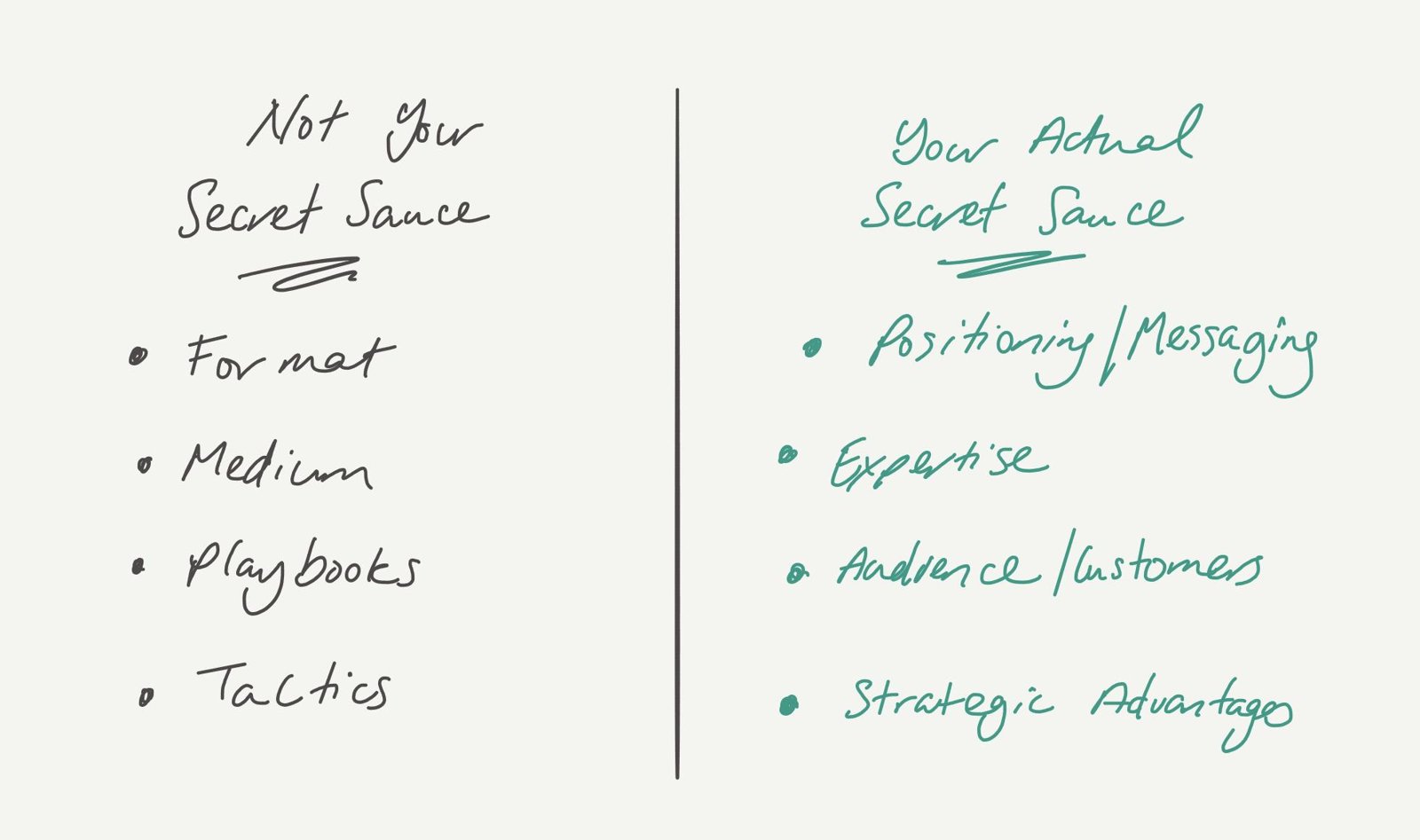
Marketers often confuse what their company’s intellectual property really is.
In the context of marketing, intellectual property refers to the intangible creations you generate through original thought.
This includes:
- A blog post (as a content format) is not intellectual property, it is a commodity.
- A video is not intellectual property, it is a commodity.
- A drawing — like this one :) — is not intellectual property, it is a commodity.
This is why as things start to work, people notice and start to make similar things — why wouldn’t they imitate something that’s working? But the medium and format are not your secret sauce.
Instead, here are things that actually create differentiation:
- Positioning and messaging
- How you solve a specific pain point
- True expertise and value provided to the customer
- Your audience and customers, and the affinity they have for the business
- Strategic advantages at the business’s disposal (e.g. supply chain, partnerships, cost efficiencies etc.)
- How effectively you execute on a bigger vision for the market or category
Anyone can imitate a portion of the whole. But it’s impossible to duplicate the sum of all the strategic pillars that make up a business.
As you better understand your secret sauce, scaling becomes easier, and competition becomes less relevant.
Drawing 30
Website messaging
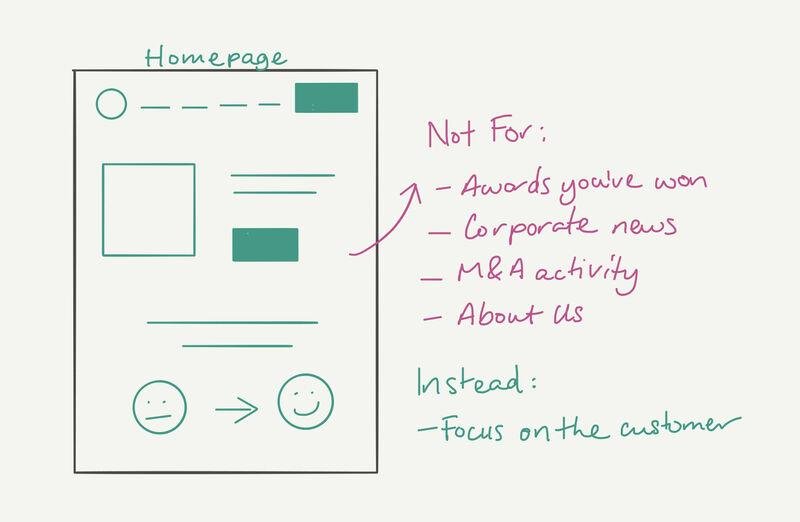
Your homepage and website are not a self-promotional tool to talk about how great you and your company are.
Your customers and prospects will encounter your website as they try to resolve a particular pain point.
Don’t waste that opportunity by talking about:
- Awards you've won, e.g. fastest growing company or local business of the year
- Companies you've acquired
- New branding you just launched
None of these things focus on what's really important: helping the customer achieve a goal — whether that’s stated or unstated. If you don’t show them how you can help within their first few seconds on the website, chances are that they won’t stick around to learn more.
Do this instead:
- Nail down your positioning and messaging, including who you help.
- Showcase the benefits of your solution and the transformation you help customers achieve.
- Include success stories and proof points to highlight how others have found success in a similar position.
Wasting the first 10 seconds you have with a prospect on anything else is wasting some of the most precious sales and marketing real estate.
Keep reading SaaS Marketing Simplified
Want to talk through how this applies to your business?
Book a time to speak with our team.