
SaaS Marketing Simplified · Chapter 4 of 10: Growth Strategy
How should a SaaS company choose its growth levers and decide how much to invest in marketing?
By Shiv Narayanan, Founder & CEO of How To SaaS
Choosing the right growth levers, and knowing how much to invest in them, determines whether marketing builds enterprise value. This chapter covers growth levers, pricing and go-to-market trade-offs, payback period and the true value of ARR and EBITDA.
In this chapter
- Growth Levers
- Stacking Growth
- Strategic Pillars
- Focus on Your Core Business
- GTM vs. CAC vs. Price
- Bottom-Up Enterprise B2B GTM
- Price vs. TAM
- Payback Period
- Equilibrium of Optimal Marketing Investment
- True Value of ARR and EBITDA
- Price vs. Service Load
- Better marketing leads to higher margins
- Total Customer Value
- Growing Your Brand vs. Rebranding
- Fix churn before demand gen
Drawing 31
Growth Levers
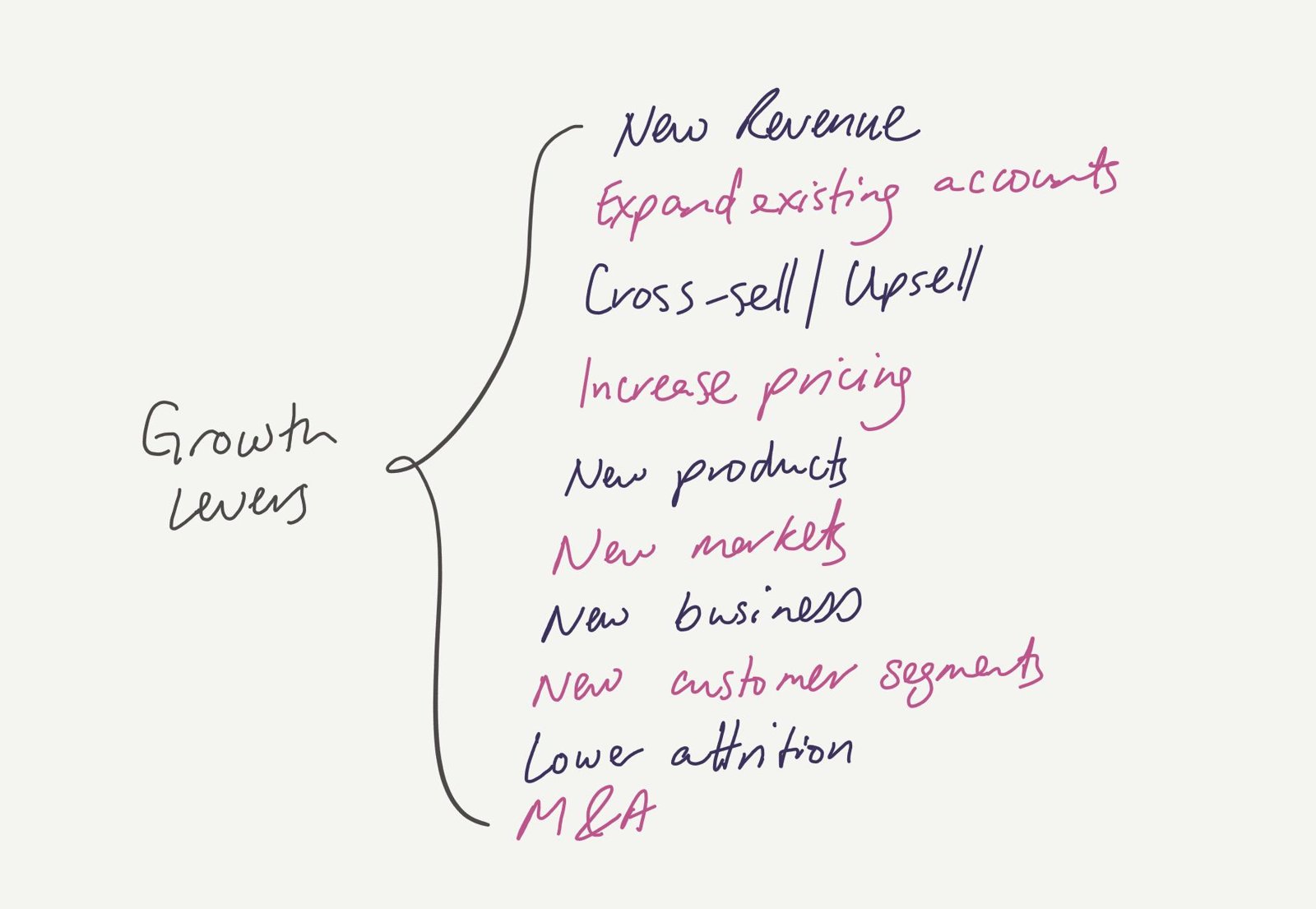
Every business has hidden growth levers.
Your job as a marketing leader is to find them and help the business capture them over time.
These include:
- New revenue
- Expanding existing accounts
- Cross-selling / Upsell
- Increase pricing
- New products
- New markets
- New business
- New customer segments
- Lower attrition
- Mergers and acquisition (M&A)
This is not an exhaustive list.
Lots of companies have tunnel vision and see new revenue as the only lever available to them. But ignoring all the other possibilities limits your growth and puts targets at risk.
The more growth levers you capture, the more enterprise value you create.
Drawing 32
Stacking Growth
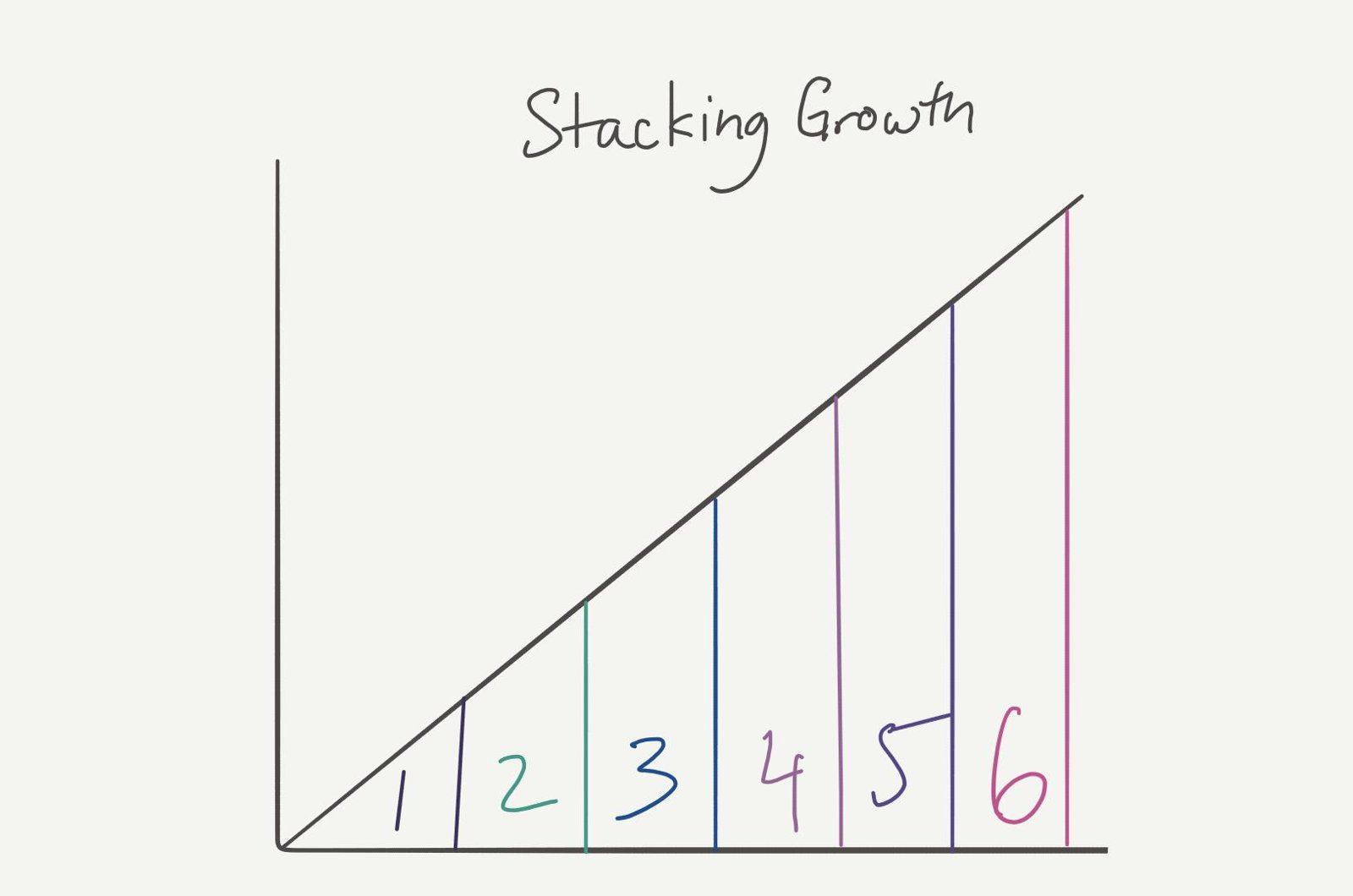
It's not one thing. It's several things.
The most popular stories around startups involve founders having a "big idea" that finally moved the needle for a business. This is usually not the case.
Usually, businesses succeed by stacking multiple, smaller building blocks on top of each other that compound growth together.
So, you need to:
- Drive awareness with content, paid media and social.
- Nurture customers as they enter your funnel with education, sales enablement and resources.
- Engage customers with an efficient and effective sales process.
- Empower customers to get to value faster with better onboarding experiences.
- Enable customers to get more value from your platform as time goes on, including bringing additional people from their orgs onto the platform.
- Expand customer value as they increase usage on the platform with more effective pricing.
- Find additional products and services to offer more value to customers.
…and much more.
You need to do it all.
It's not one thing. It's several things. Don’t get so caught up waiting for that mythical ‘big idea’ that you miss all the growth opportunities that are in front of you.
This is why it takes time to build an enterprise.
Drawing 33
Strategic Pillars
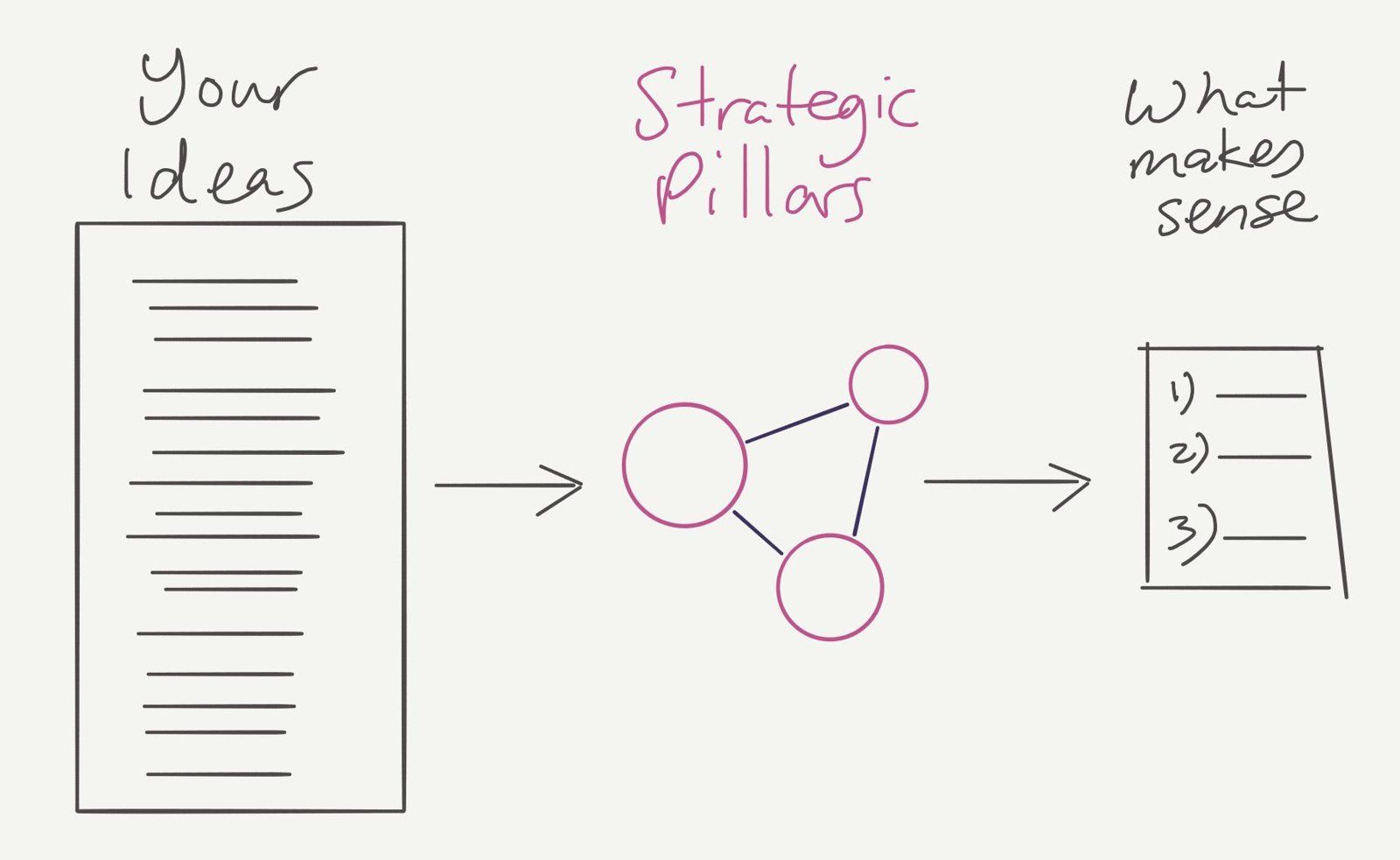
Not every good idea is worth pursuing.
Each business has core strategic pillars that are deeply interconnected and intertwined into the fabric of the organization. Can you imagine if Ikea started selling high-end, customized furniture?
This is why filtering your ideas through your strategic pillars is critical. When you go through this exercise, you realize most ideas aren't a good fit for your business.
Where companies get caught is when they start with the dollar value in certain ideas. They work backwards from there to figure out how to make it happen.
Along the way, these companies lose their strategy and forget what business they're in. This outside-in strategy also jeopardizes the core business.
Instead, start with your strategic pillars and build from the inside out. Don't chase after every shiny revenue opportunity.
Drawing 34
Focus on Your Core Business
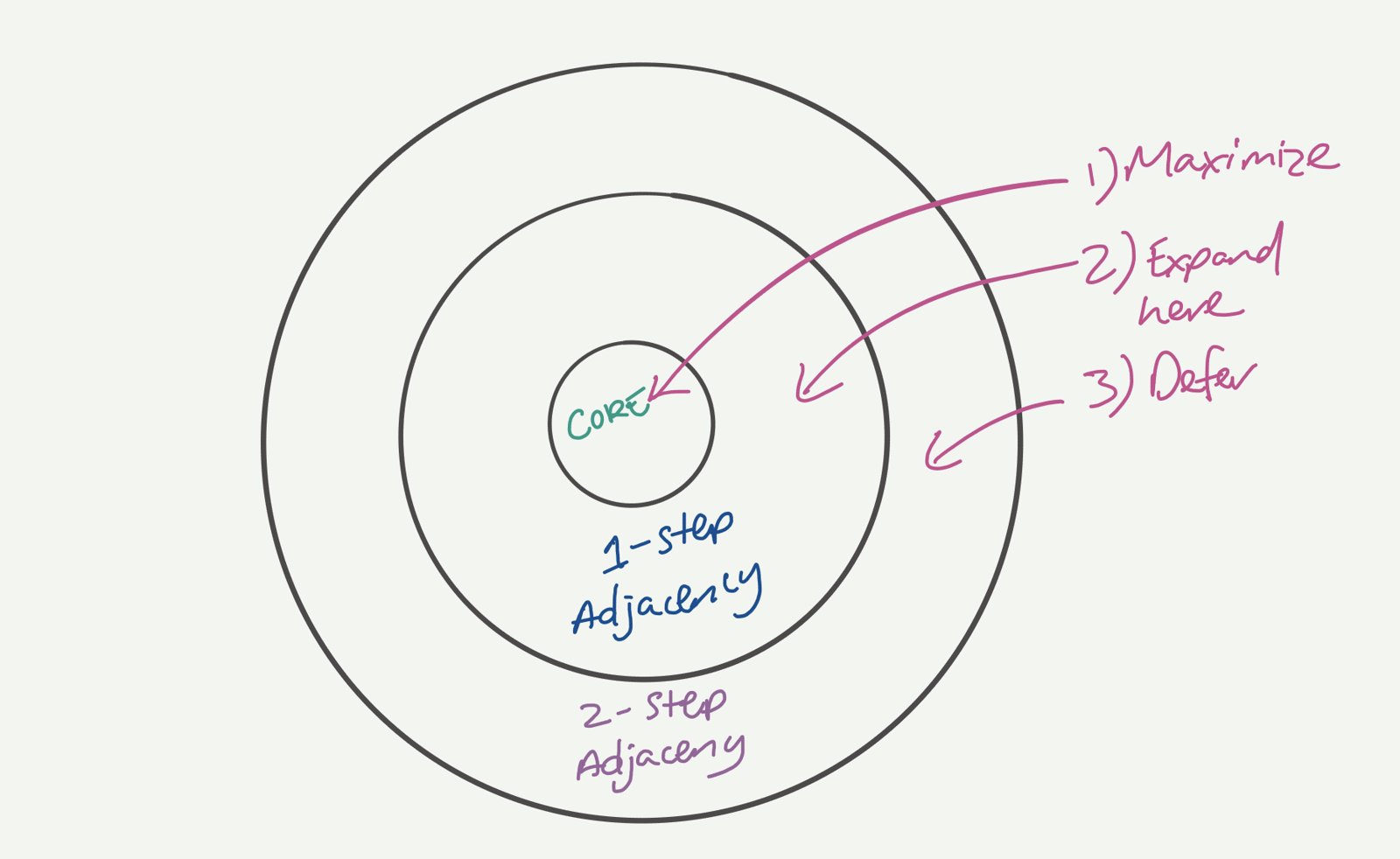
Too many companies fail because they overextend themselves beyond their core business. This is why so many companies raise money, expand (e.g. with a hiring spree) and then contract (e.g. with layoffs).
Here's a sustainable way to expand instead:
- Define your core business, competitive advantage and differentiators.
- Strengthen your core business and maximize returns here.
- Expand to one adjacency away — e.g. new products, new business, new supply chain steps, new geographies etc. Ensure the adjacency you bet on leverages your core business strengths and advantages.
- Reset and redefine your new business in light of the adjacency.
- Repeat.
Avoid jumping two steps away with the delusion of trying to conquer the world. If you're jumping two steps away, you're likely entering an adjacency that is the core business or just one step away for someone else, and that’s a recipe for disaster.
As a marketing leader, it’s part of your role to advocate for a growth strategy that is sustainable and makes sense for the core business.
Drawing 35
GTM vs. CAC vs. Price
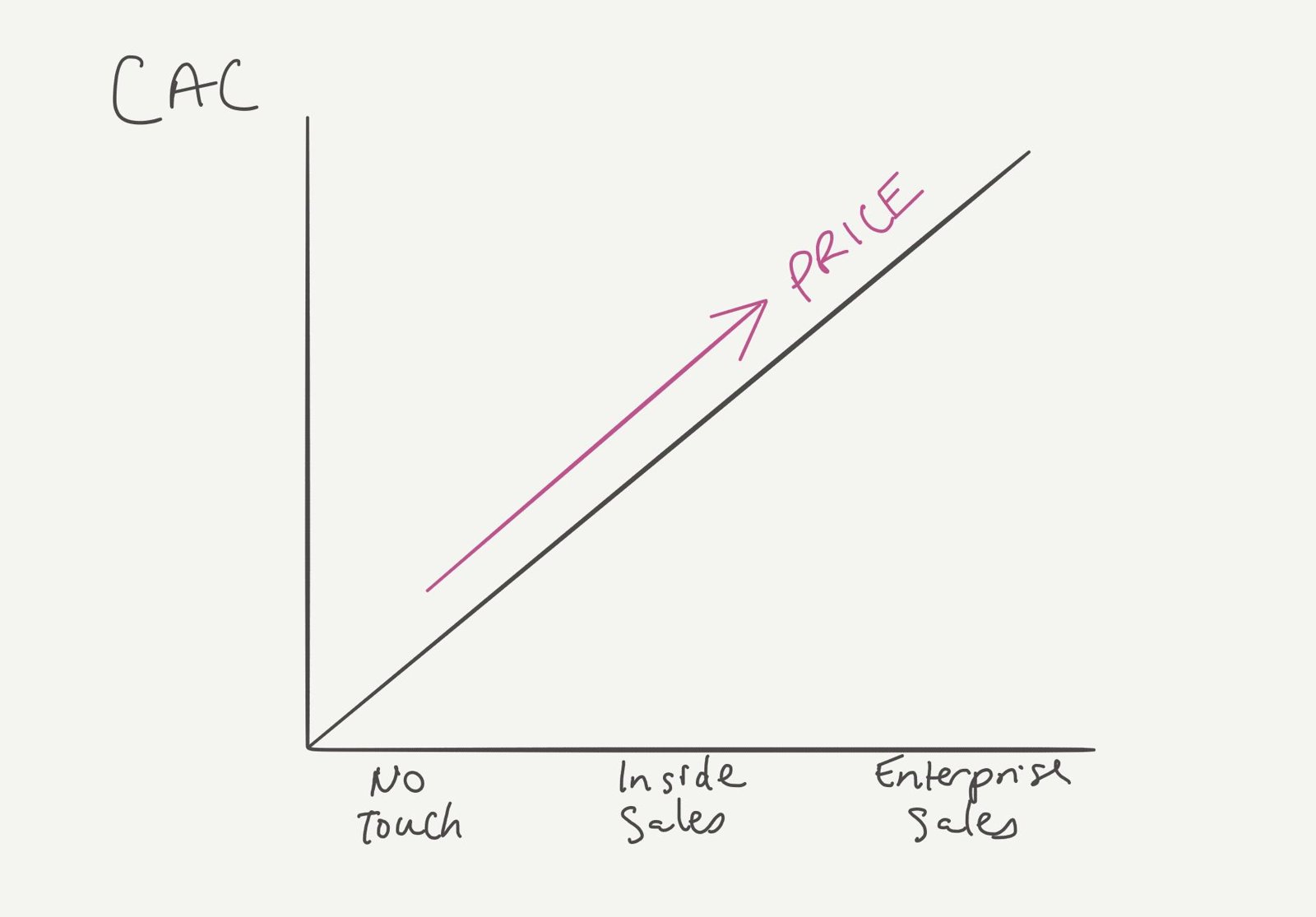
There's a reason why two products that bring roughly the same value are often priced very differently.
Your chosen Go-To-Market model drastically impacts your Customer Acquisition Costs.
If you have an expensive enterprise sales team, you inevitably have to charge more for your product to keep your CAC in check, and you may be pricing yourself out of the reach of some customers.
Conversely, if your Go-To-Market can be a low-touch (or even no-touch) model, you bring those acquisition costs down significantly. You can then pass along those savings to your customers in the form of a lower price.
That's the key: customers win when you have a more efficient Go-To-Market.
Better marketing -> Better unit economics -> Lower price -> Customers win -> Higher satisfaction -> Larger market to capture.
Drawing 36
Bottom-Up Enterprise B2B GTM
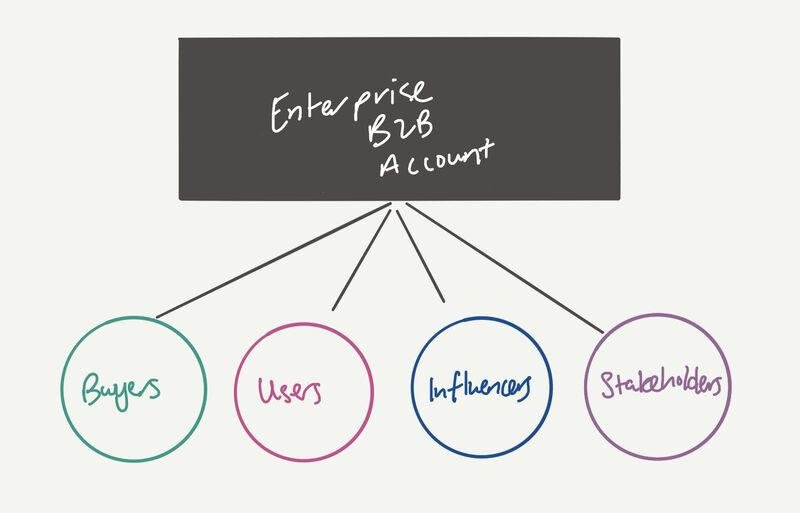
Taking a top-down approach to Enterprise B2B accounts limits possibilities on Go-To-Market because TAM is often limited to a small set of very valuable accounts.
You need to expend an incredible number of acquisition dollars to land $100K-$1M+ deals. Often, this work is led by Sales since 1-to-1 outreach is required.
Marketing ends up focusing on ABM to drive demand, supporting the 1-to-1 outreach with 1-to-1 content and messaging.
While this is required in a lot of cases, you can solve the problem of limited TAM by expanding the universe of people who drive decision-marketing for an enterprise account.
This means:
- Marketing to buyers, users, influencers and stakeholders of your solution, so you can target a far larger audience to drive demand more efficiently.
- Building a product that individual users can adopt and then collectively influence the buying decision of the overall enterprise organization.
- Targeting individual users via inbound demand gen campaigns, then mining user data to identify larger enterprise accounts in the limited TAM that are ready for a bigger purchase.
Very few companies have mastered this bottom-up approach (e.g. Expensify, 1Password). When it’s rolled out effectively, growth can scale much faster in enterprise B2B models.
Drawing 37
Price vs. TAM
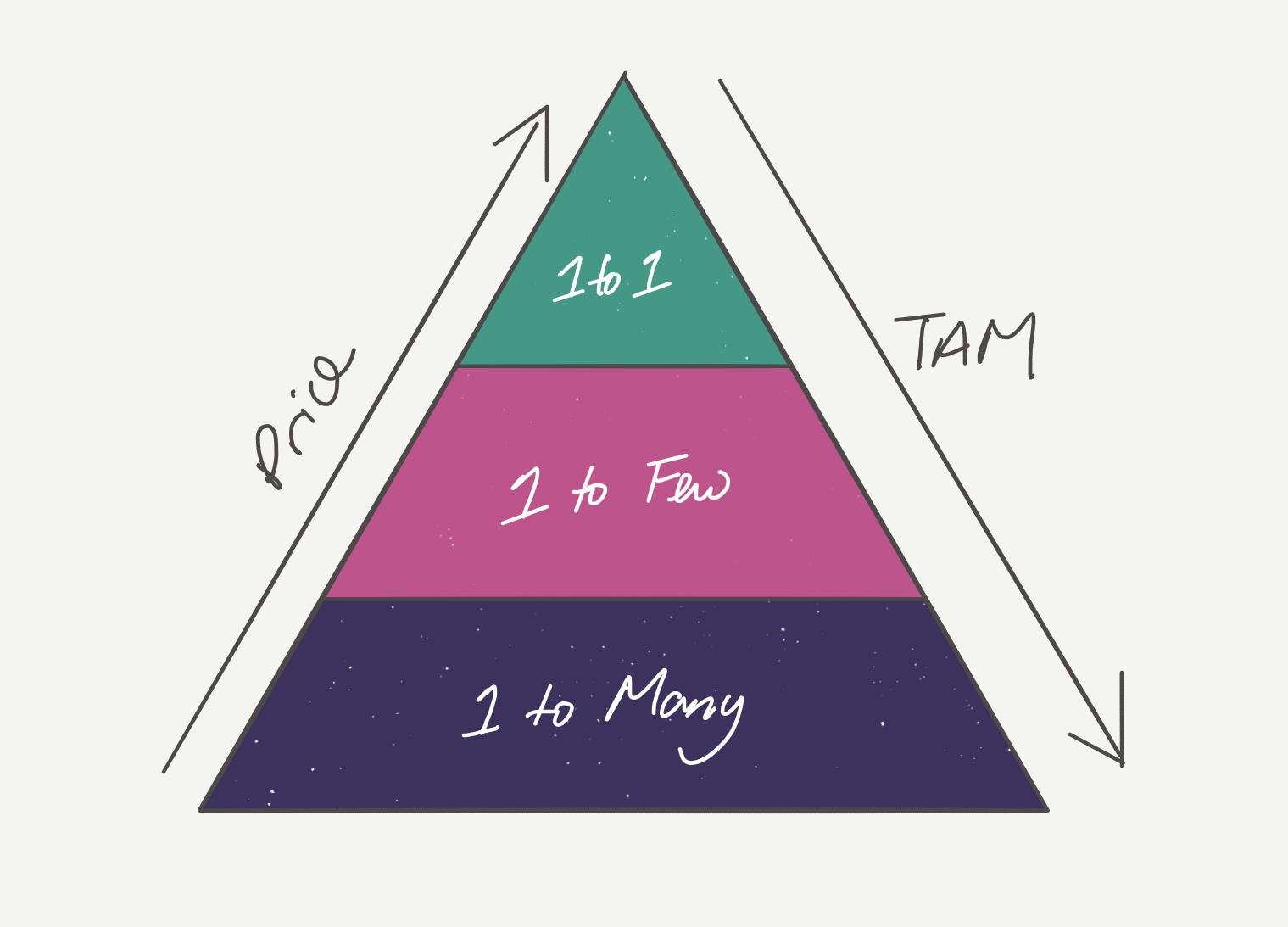
Your price point and Total Addressable Market play a huge role in your Go-To-Market.
Large TAM, low price -> Take a one-to-many approach, drive volume and focus on efficiency. Inbound marketing should be at the core.
Small TAM, high price -> Be super customized and personalized in your marketing. ABM should be at the core.
Somewhere in between -> Mix both approaches for a happy medium.
This is why it’s important to start with your company's specifics. Don't just buy an ABM solution because you watched a video from a martech vendor. Companies spend a lot of time and energy on campaigns that were never a good fit for their business reality.
Truly understand your business and figure out which approach best fits your reality.
Drawing 38
Payback Period
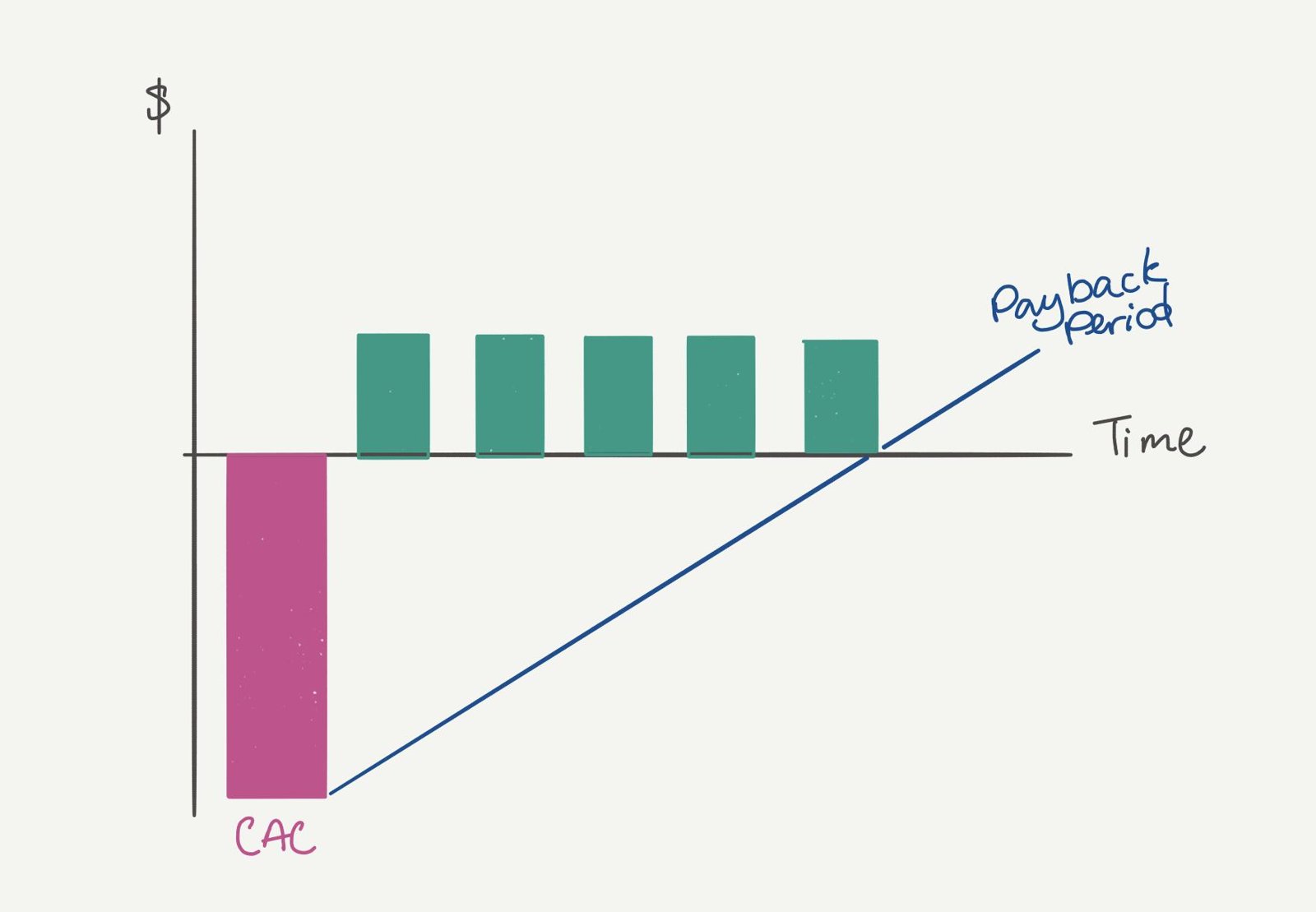
CAC Payback Periods should guide marketing decisions a lot more than they currently do.
If you’re not keeping your CAC Payback Period top of mind, you could be overspending on bad channels that take years to break even on acquisition. Alternatively, you could be missing out on more deals by spending a fraction of what you can afford to.
At the micro level: if channel X is breaking even in 6 months, while channel Y is breaking even in 18 months, it's clear where you should allocate and scale spend.
At the macro level: if Marketing as a function is breaking even in less than 12 months, then you should scale spend aggressively. You can then drill down into channels and campaigns to see where you can scale spend within marketing.
While you can’t measure the performance of some marketing activities, looking at Payback Periods can unlock significant growth levers for marketing teams.
In order to make decisions at this level, you need to create the right data infrastructure to measure Payback Periods at both the micro and macro levels.
Drawing 39
Equilibrium of Optimal Marketing Investment
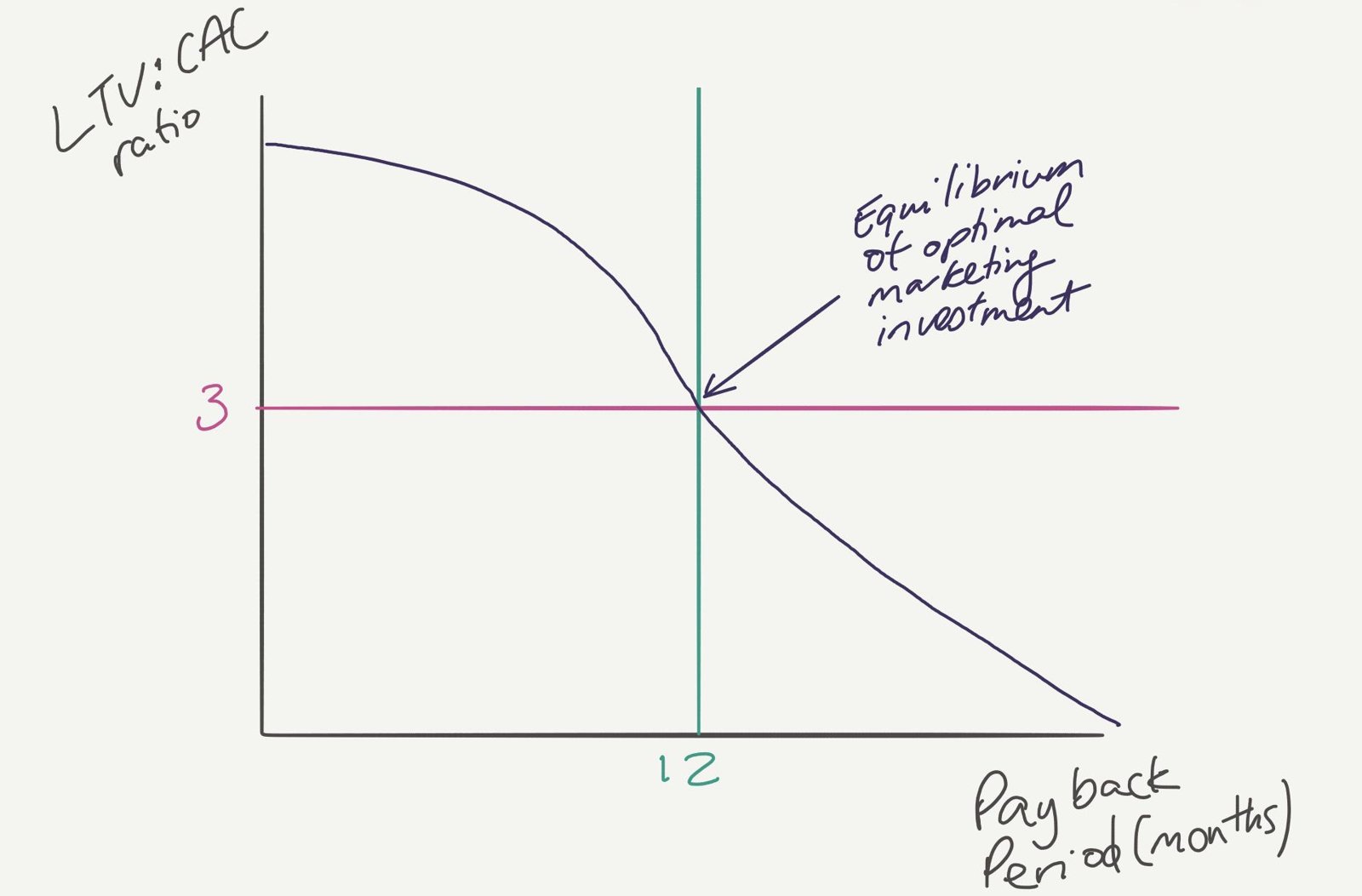
LTV to CAC ratios are incredibly high in many B2B companies. Yet the same companies hold back on ramping up marketing spend — and miss out on marketing-generated revenue as a result.
If your LTV:CAC ratio is well above 3 (in many companies, it’s north of 10) and your Payback Period is less than 12 months, ramping up sales and marketing spend aggressively can create a tremendous amount of enterprise value.
Why hold back any spend when you'll recover your investment in less than a year and generate returns for 10+ years?
If your break-even point on marketing spend is at the 18-24 month mark and your LTV:CAC ratio is still above 10, it's time to optimize and analyze what's working and where spend is being wasted. Once optimized, scale aggressively again.
If LTV:CAC is below 3 and the Payback Period is north of 12 months, it's time to go back to product and customer feedback before you think about investing more into acquisition.
Drawing 40
True Value of ARR and EBITDA
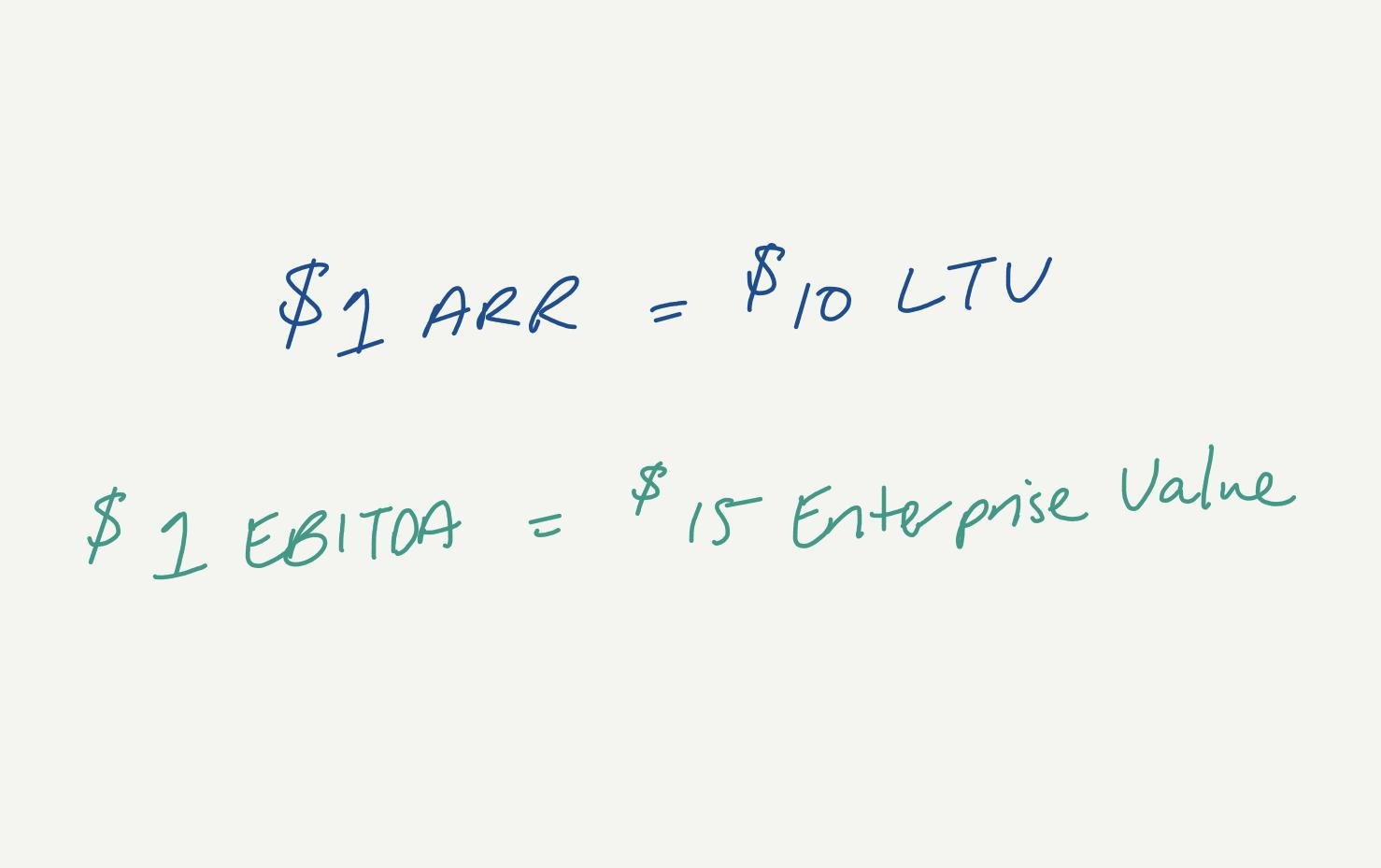
Understanding the true value of revenue and profit generated is key to knowing how much to invest in Marketing.
If your client LTV is 10 years and you’re not cash strapped, increasing your CAC Payback Period to 18-24 months can drastically increase your speed to acquire customers.
While financial stewardship is critical to scale, knowing when to step on the gas can lead to significant gains.
This is when Marketing can do things like:
- Build more brand awareness at the top of the funnel
- Invest heavily in content to generate long-term returns
- Scale paid media to outbid the competition that has more stringent cash constraints
Similarly, realizing that generating EBITDA (earnings before interest, taxes, depreciation and interest) has a 15x (likely more) multiple on exit or in fundraising rounds can change how you (and the entire C-suite) view Marketing investment.
Short-term thinking may view this as conserving EBITDA for higher valuations. Long-term thinking looks at long-term EBITDA creation instead.
If you expand Payback Periods to 18-24 months but you can win a much larger percentage of the market, inevitably EBITDA will increase significantly more than if you kept Payback Periods under 12 months.
Drawing 41
Price vs. Service Load
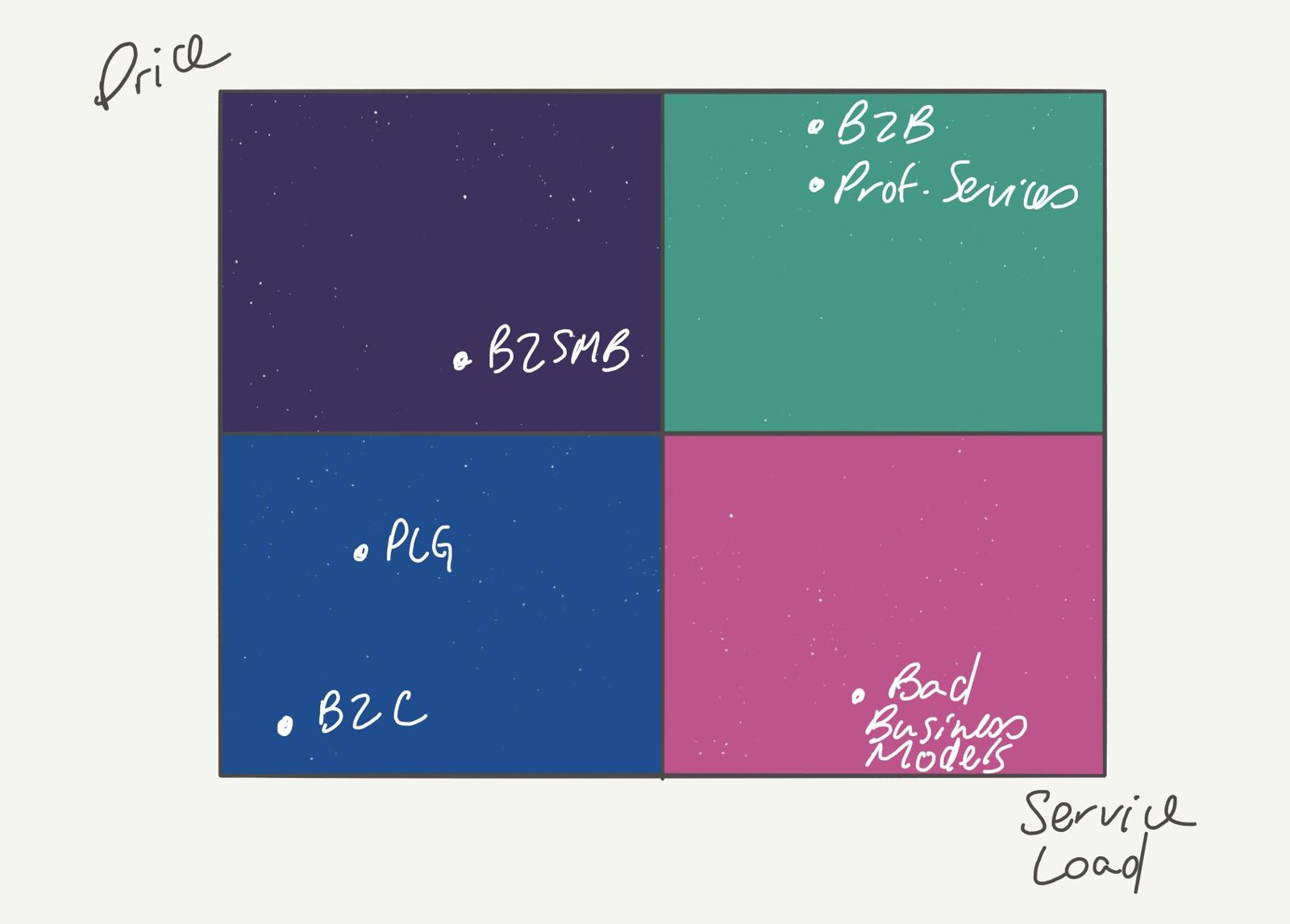
Every business should aspire to be in the top left quadrant, where price is high but service load is low. This is where margins are the highest and you can reinvest them into building an even better product and business.
This is why some of the biggest companies in the world are B2SMB SaaS companies. Shopify, Hubspot and Atlassian all fit in that quadrant.
It’s also why Product-Led Growth companies with price points around $1K eventually end up trying to move upmarket. And why B2B enterprise companies try to lower their service load with better software that needs less customizations.
That quadrant is where the most value is created for the customer as fast as possible. There is more automation, better self-service, more transparency, better outcomes, and better experiences.
It’s a win-win situation.
Marketers need to understand which quadrant the business is in and build your strategy accordingly. A high price, low service load product will have a different audience and different Go-To-Market than a low price, low service load product.
Drawing 42
Better marketing leads to higher margins
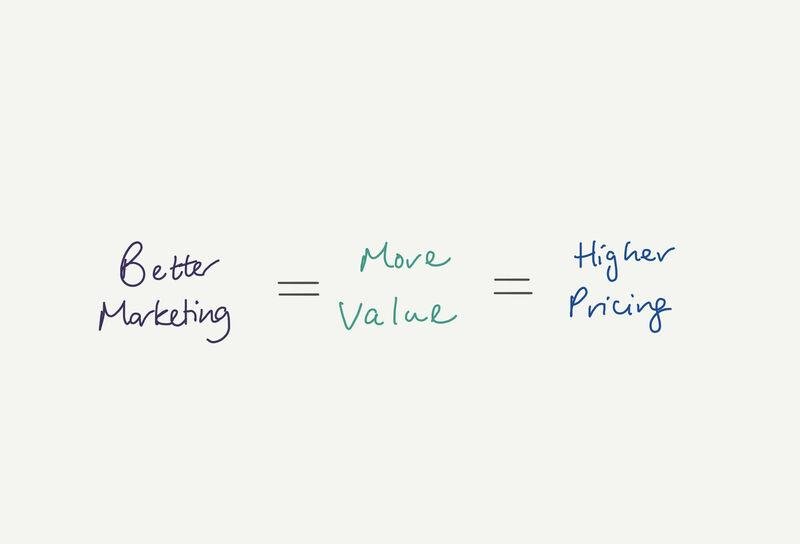
Better marketing leads to higher pricing and improved margins.
The more you invest into your messaging, positioning, content, education and thought leadership, the more your perceived value in the marketplace increases.
If your business is built to consistently deliver on this increased perceived value, it translates to increased actual value experienced by customers. This can come in the form of specific solutions, verticalized offerings, purpose-built products and much more.
The combination of the two creates a unique and differentiated position in the marketplace, where customers are willing to pay a premium because they expect a higher value to be delivered by your offerings.
Drawing 43
Total Customer Value
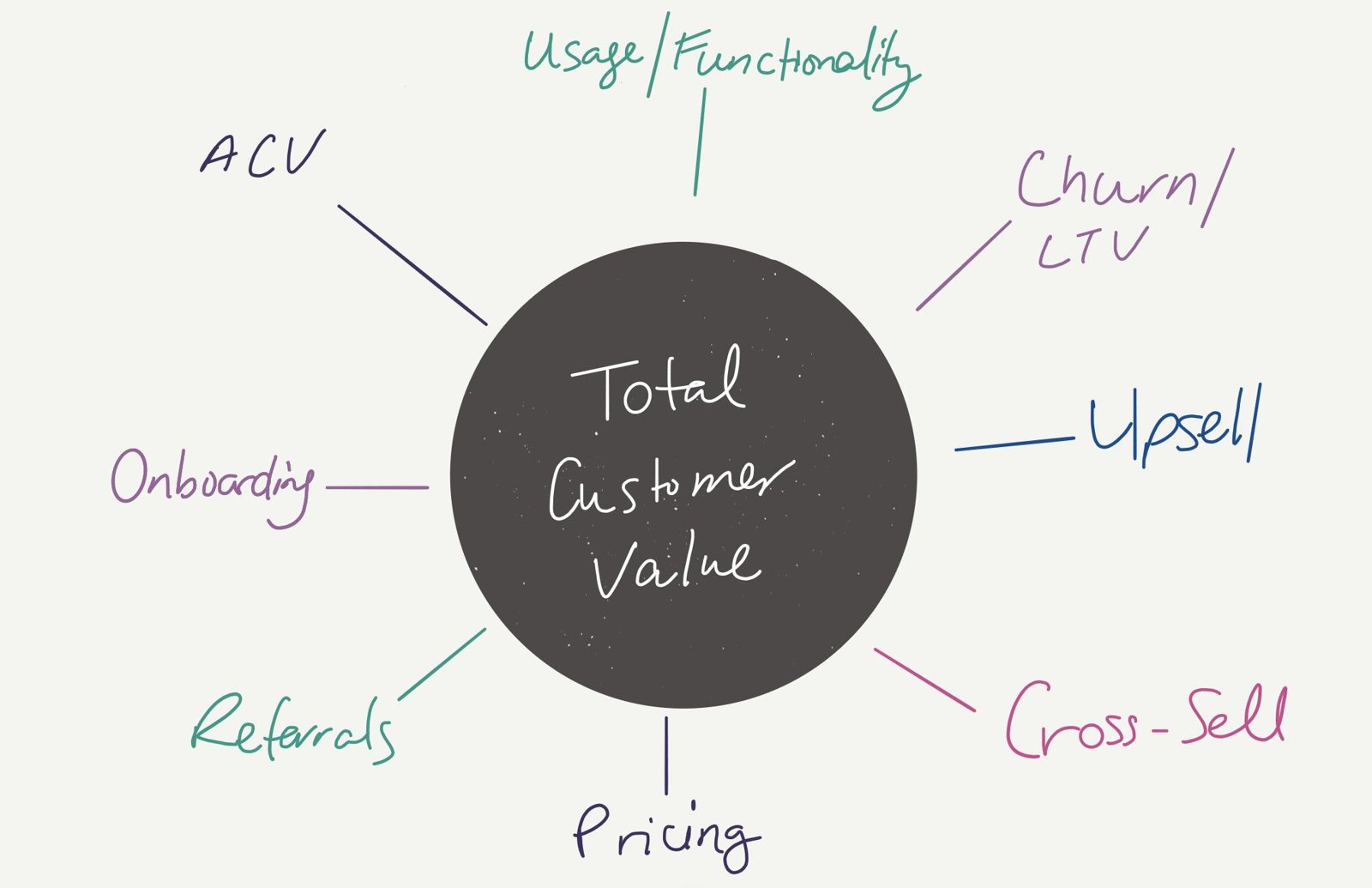
Understanding the core drivers of Total Customer Value (TCV) is critical to building your business’s growth engine.
Companies constantly underestimate what a customer is truly worth by not capturing all the value acquiring a customer brings. If you’re underestimating customer value, you’re probably underinvesting in acquisition, which drastically reduces your chance of hitting targets.
Common drivers of TCV:
- Higher annual contract values (ACVs)/average deal sizes
- Increased usage/functionality which drives expansion revenue
- Lower churn, higher retention and higher LTV
- More upsells
- More cross-sells
- Increasing pricing
- Driving more referrals through higher NPS/satisfaction
- Better onboarding to increase conversion rates and usage
Correctly understanding Total Customer Value is key to scaling sales and marketing. It tells you how much you can truly spend to acquire a customer.
The higher the Total Customer Value, the more you can spend. The more you can spend, the more of the market you can capture.
Drawing 44
Growing Your Brand vs. Rebranding
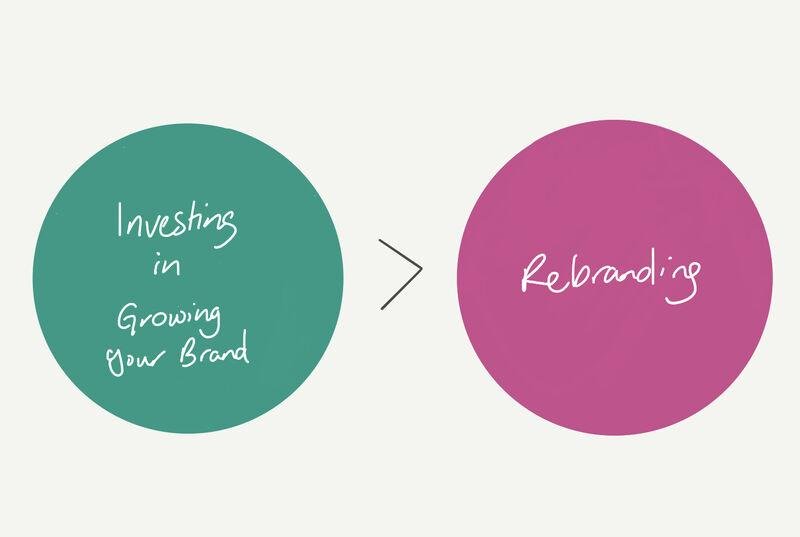
Rebranding is more expensive than companies and their marketing teams realize.
Every year, Marketing teams invest hundreds of thousands of dollars into changing the brand, logo, website, tagline etc. for companies that likely don’t need the change to begin with.
Along the way, political capital is wasted, VPs of Marketing get fired and current brand equity is squandered. Most importantly, revenue does not go up.
The bigger the company, the more the waste. E.g. A rebrand for a Fortune 500 company can cost millions of dollars in new marketing collateral, website changes, building signs, retraining of sales teams etc. At the same time, smaller companies can waste limited resources on a rebrand that doesn’t meet the ultimate goal of driving growth. Reasons cited for these brand overhauls include:
- Increased M&A activity and needing to tell a bigger story
- Current branding not matching what the company really does / offers
- Needing to differentiate from competitors
- And much more
While these reasons are valid, there is a painful truth most companies miss: the customer doesn’t care about cosmetic changes. What the customer cares most about is the real value your company brings. This means that, regardless of your brand name, colors or taglines, customers want to know how you will make a real difference in their lives.
So, unless it's absolutely necessary, take the same dollars that would be wasted on a rebrand and invest it into growing your brand. What this work looks like:
- Educating the market on your brand story and differentiated position
- Creating exceptional content that resonates and generates true engagement
- Ramping up demand generation across all channels from your ideal customers
- Increasing awareness from the broader market so that more prospects are aware of your offering
- Building loyalty from your existing customers by continuing to deliver value
This is the really hard work of building a brand. Anyone can change some logos and colors.
Drawing 45
Fix churn before demand gen
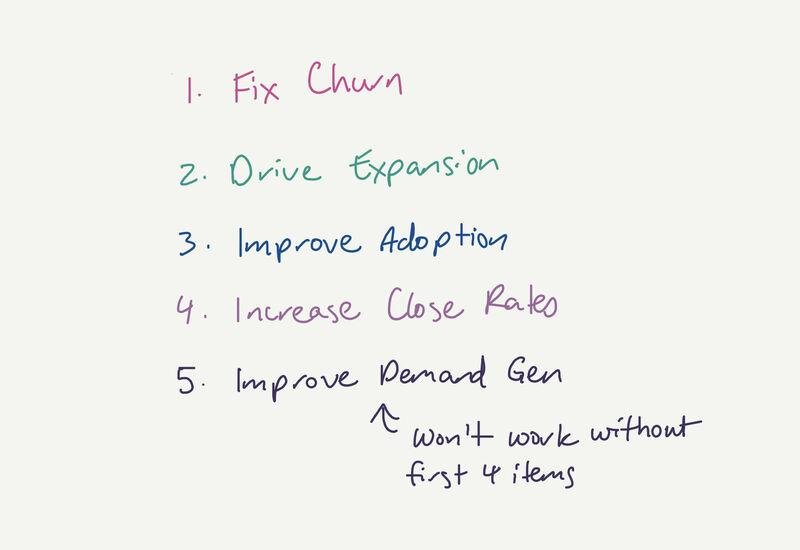
Focusing on demand gen is a mistake when other fundamental pieces of your growth engine are broken.
The 4 essential areas to focus on:
- Fix Churn: Improve metrics like 90-day retention, LTV and net retention.
- Drive Expansion: Scale revenue from your existing customer base with cross-sell and upsells.
- Improve Adoption: Increase usage from customers with better onboarding as they try or buy your product.
- Increase Close Rates: Ensure your SQL to Close Rates are above 30%, ideally above 40%.
Once the above 4 are handled, focusing on improving demand gen becomes a lot easier.
You can spend a lot more money to acquire customers because your ACV/LTV is higher and you need fewer leads to reach CAC Payback Period.
Keep reading SaaS Marketing Simplified
Want to talk through how this applies to your business?
Book a time to speak with our team.